


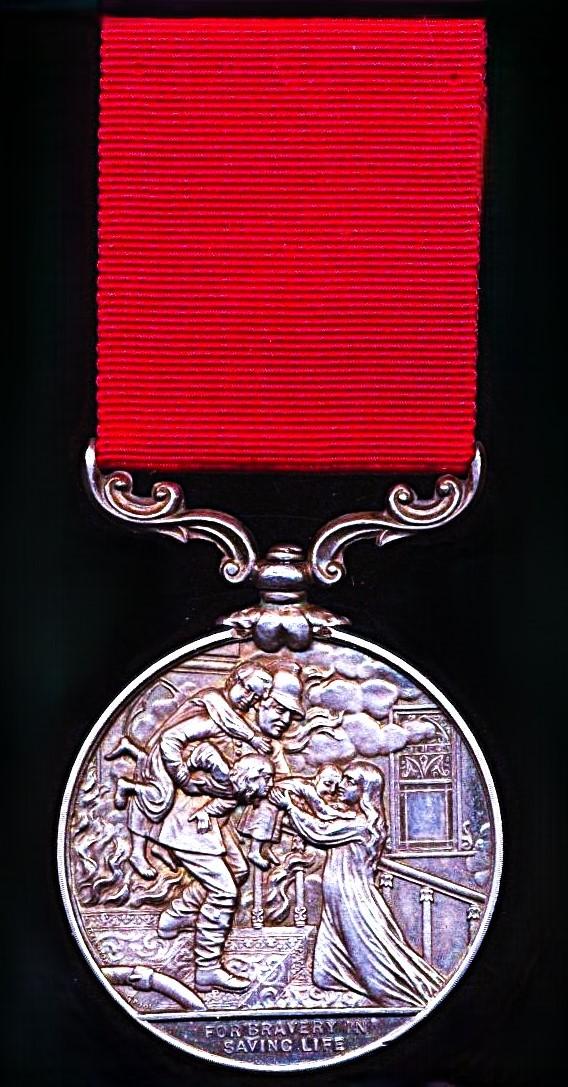
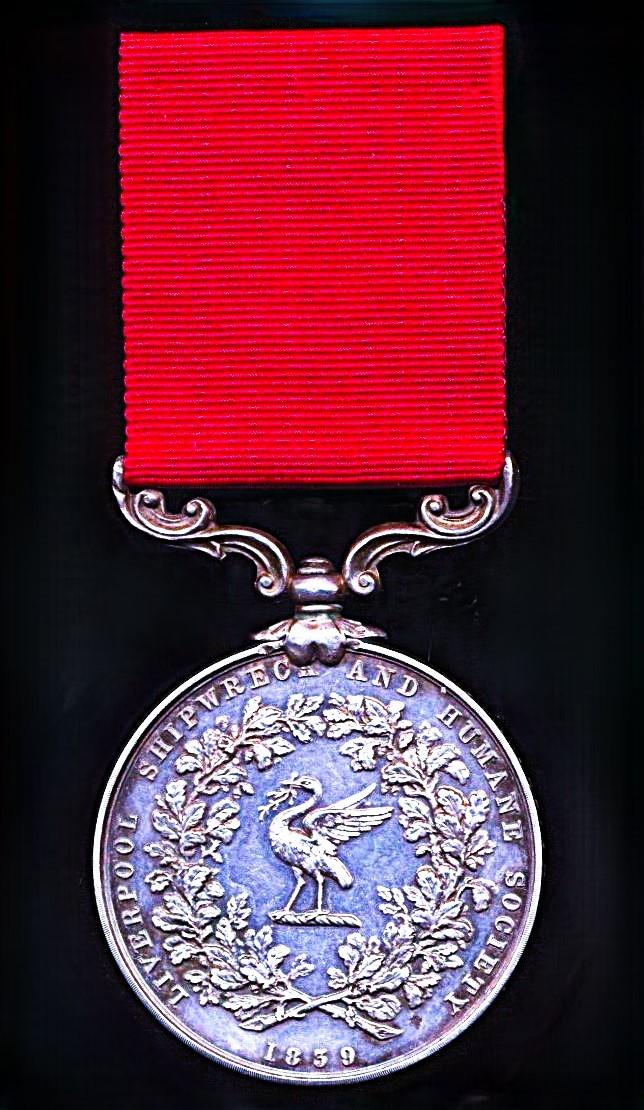
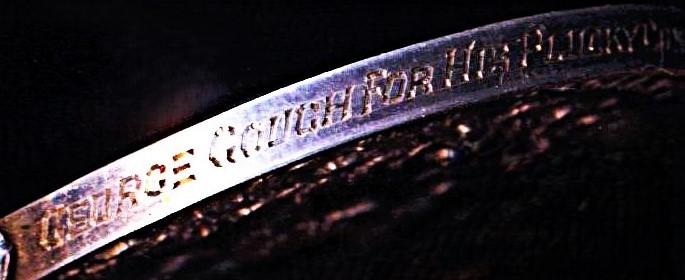
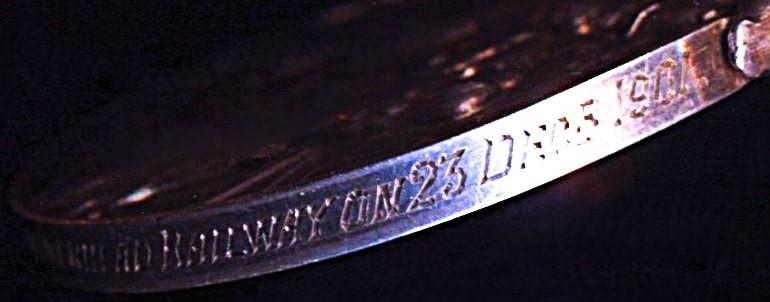
Liverpool Shipwreck and Humane Society, Fire Medal, silver ('George Gough For His Plucky Conduct At The Fire At Dingle Station Overhead Railway On 23 Decr 1901')
Note the engraved naming takes up the entire rim of the medal, and is a masterclass in the art of the engravers craftsmanship
Teenager Recipient: The recipient is recorded as being only 16 years of age - and quite possibly the youngest recipient of the Liverpool Shipwreck and Humane Society Fire Medal
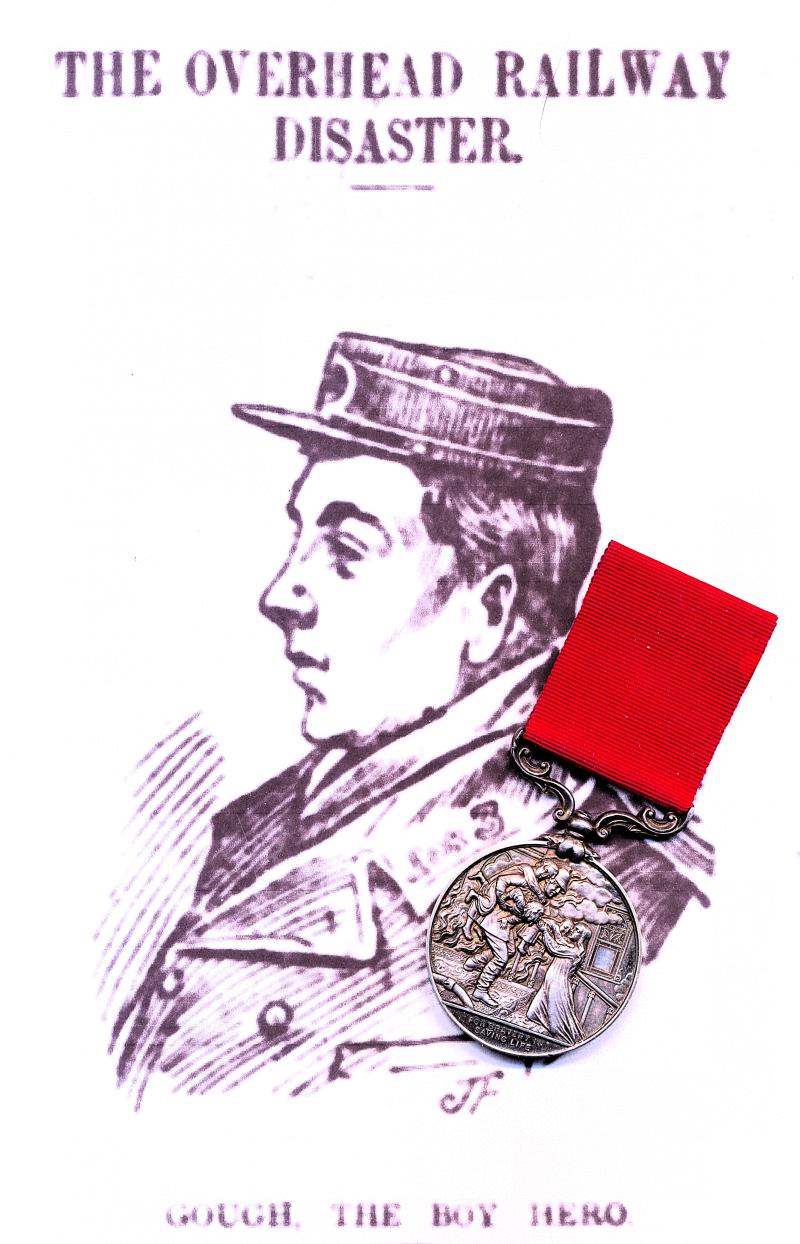
Pen & Ink Portrait Sketch: The recipients portrait wearing his Railway peaked cap and uniform jacket was published in the 'Liverpool Echo', newspaper issue of, 3 January 1902, with caption 'Gough The Boy Hero'
Official Recommendation:
Quote,
‘Silver Fire Medal, Vote of Thanks, and £2 each to George Gough and William Owen, for their timely and plucky action at the fire at the Dingle Station of the Liverpool Overhead Railway, on December 23rd, 1901, when they were instrumental in saving the lives of several passengers.’ (Extract from the 63rd Annual Report, year ended 1st July 1902).
The Liverpool Overhead Railway (known as the ‘Docker’s Umbrella’) ran from Gladstone Dock to Dingle, a distance of some 7 miles. Dingle Station was in use between 1896 and 1956
Unquote.
On 23 December 1901, a motor on a train pulling into Dingle Station fused which sent sparks which ignited some wooden sleepers by the railside. The resulting fire spread from the sleepers to the passenger carriages and thence to the station itself. The fire caused the death of six people
Both of the silver medals awarded for the Dingle Station / Overhead Railway Disaster, are known to be extant. The medal to William Owen recorded to have sold in London, February 2019
Whether George Gough was the youngest ever recipient of the Liverpool Shipwreck and Humane Society, Fire Medal (silver), is not presently known to us, however he would certainly be in contention for that attribute, basis being only 16 years of age at the time of performing his repeated selfless life-saving acts of bravery (see the Cheshire Daily Echo newspaper issue of 28 December 1901, which refers to the gallant lad's age)
For the best detailed account of the recipients services at the scene of the train disaster - in which 6 x passengers lost their lives - read below his own witness evidence testimony rendered to the Railway Department Board of Trade, and contained in their report dated London, 22 February, 1902 that we are quoting below:
Quote,
Goorge Gough said: I am train booker in the
employ of the Company, and was on duty on the
afternoon of Monday, the 23rd of December. It
was. my duty to stand in the signal box with
Owen and book the trains as they passed the
cabin in and out. I was in the cabin when the
5 o'clock train ex Seaforth, due at 5.32, was.
coming up the Dingle tunnel. It was about three.
minutes late. I was standing at the window, waiting to catch the numbers of the coaches, and I saw the train suddenly stop and the lights in the
train go very low. A short time after the train
came to a standstill, I heard the guard, Maloney,
shouting out for hand lamps. The electric light
in the station had then gone out, and all was dark.
Owen handed me two lamps. One of these 1
gave to O'Brien, and we went down to the train.
There was only one coach alight then-the rear
one. Even then it was a big blaze. The passengers were all coming out. One passenger
refused the hand lamp which I offered him, as he said how could find his own way without it. I heard Rendell twice tell the passengers to make
their way upstairs as soon as ever they could, but
several of them stood by on No. 12 siding by the pile of sleepers, they didn't appear to pay any attention to what Rendell said. If they had all
gone off when I first went down they would all
have been saved. I alighted three passengers from
the train to the bottom of the staircase. I then
returned to the train. On my way I picked three fire extinguishers up and handed them to Maloney,
who, with Ashbee, was doing all he could to put
the fire out. I then guided five more passengers
from the train to the bottom of the staircase. I
left O'Brien at the top by the signal box as he
couldn't work any more; and I gave his lamp to
one of the passengers. After seeing these five
passengers start up the staircase I returned for
O'Brien. I found him still by the tap. He was partially unconscious, and I had to shake him. I led him to the staircase and hoped he would
make his way up. I heard someone shouting on
the permanent way on the up line, about opposite
the signal box. I crawled back along the platform on my hands and knees and found a passenger at the point indicated. He was moaning. I
had previously wetted my coat and put it over my head. I led him to the platform and about half
way along it, when he told me to leave him, as he
couldn't go any further. He handed me a note
to deliver. I unfortunately lost this. He had a
light coat on and spectacles. I struggled along
the platform, but fell off it on to the permanent
way. At this time I heard Owen running along
the platform. I knew it was him as I recognised
his step. I eventually reached the slope on to
the platform. I found my way up the staircase
and passage into the booking hall. At the
entrance I was met by driver James, and I do
not remember any thing further till I found myself
in the hospital. I was not burnt at all, nor were
my clothes singed. I had got under the tap and
soaked all my clothes, I can account for O'Brion's
movements up to the time I left him at the
bottom of the staircase, and I do not think that
he can have taken shelter in the foreman's hut
I have no idea how he came to wander down to
the end of the platform where he was found. I
left him at the foot of the stairs-I am sure of
that-on the down side. I went the way the passengers go up-the proper way out. After that I
went back on the up side, and tumbled into the
four-foot, and then crawled up the slope on
my hands and knees and got up again. I could
see nothing before me at that time. Our gas in the
signal box kept alight. The electric light in the
station had gone out. I could not say how long
that was after the train had come to a stand.
The gas light was burning through the fog.
There is no doubt it was there. I just heard the
conversation between the driver and the guard.
The guard shouted to the driver. I think it was
to ask the signalman to let him come straight
in on the straight run. I then heard a shout from
the driver to the signalman. I saw flashes come
from the train at the rear end after it came to a
stand. I saw the driver come out of his box and
examine his train. After the shouting we went
with lamps to them. The passengers were
coming out then, and the driver stood in the
siding watching his train. I should say tthere were 15 to 18 passengers. Some of them
went away at once, and some of them stayed
behind to look at the train burning. Those I let
out would be some of them. Those who went away
at once did not need any assistance. I got away
after Owen did. I was the last out of the station.
"The first set of passengers walked straight away from the train; the others remained, but bye-and-bye began to move. I should say fully ten
minutes elapsed between the two sets moving
away. The last lot stood there watching in the siding, and the foreman, Rendell, remarked to
them that if they valued their lives they should
go, but they took no further notice of him. He
cautioned them and told them to go. They had
got off the platform on to No. 12 siding by the
sleepers. They were standing alongside the
train and watching it-some were right opposite
the second smoker. When those passengers
began to move out the middle carriage was well
on fire. I should think there were five or six
passengers there then.
Unquote
Both of the silver medals awarded for the Dingle Station / Overhead Railway Disaster, are known to be extant. The medal to William Owen recorded to have sold in London, February 2019
Whether George Gough was the youngest ever recipient of the Liverpool Shipwreck and Humane Society, Fire Medal (silver), is not presently known to us, however he would certainly be in contention for that attribute, basis being only 16 years of age at the time of performing his repeated selfless life-saving acts of bravery
Condition: Toned about EF
Code: 26360