


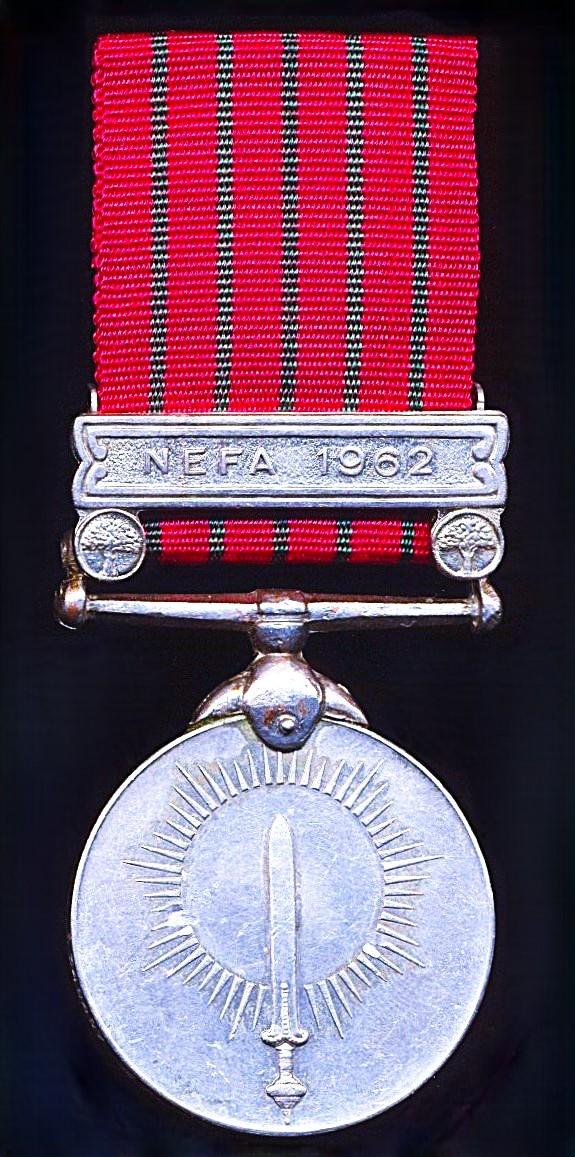
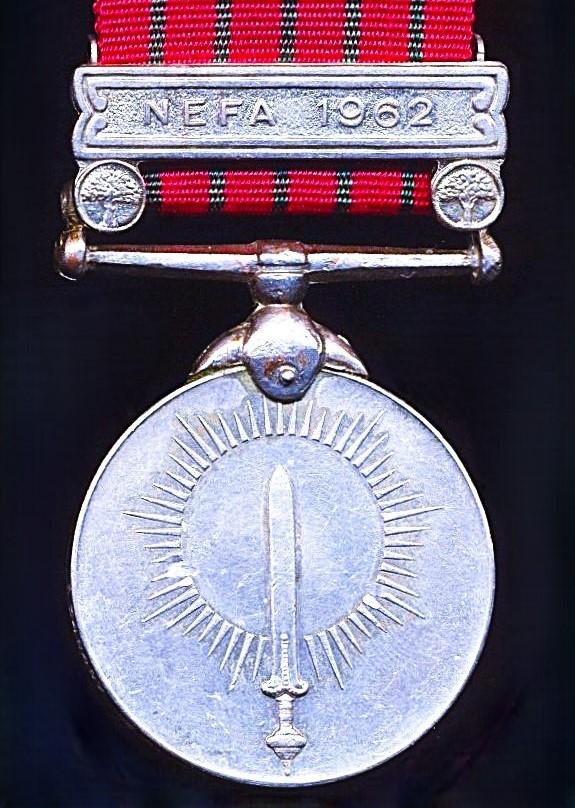
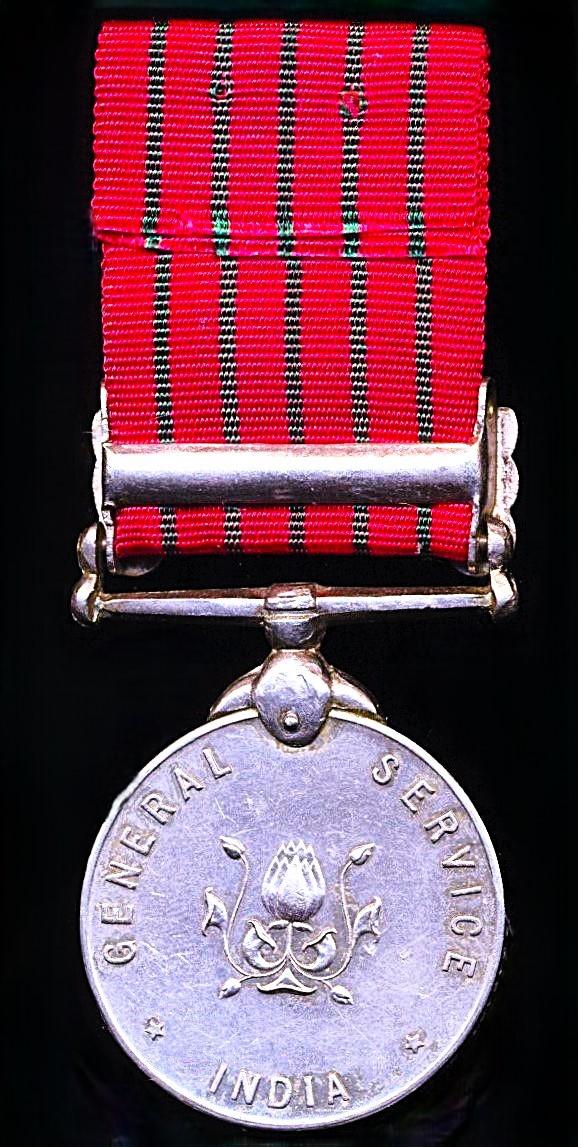
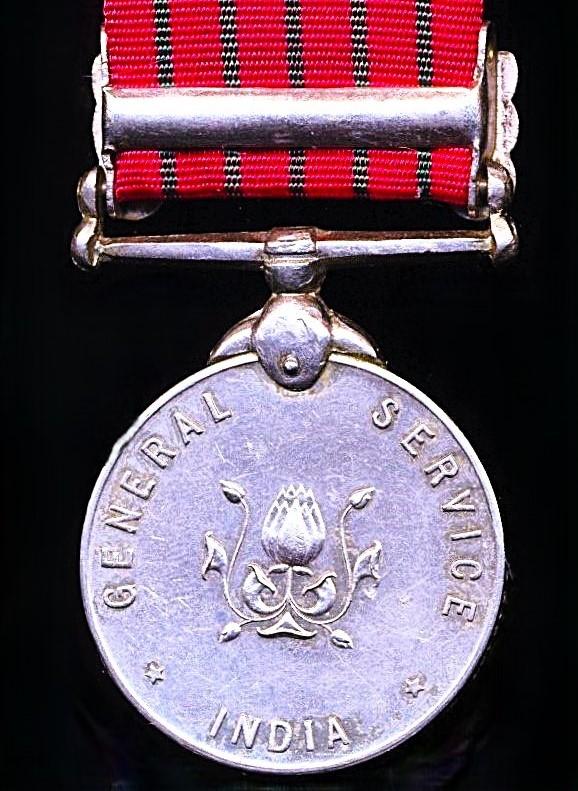

India: General Service Medal 1947-65. With clasp 'N.E.F.A. 1962' (3348467 Sep. Parmatma Singh, Sikh R.)
The recipient Parmatma Singh was an Indian soldier of the Sikh faith who held the rank of Sepoy while serving with Battalion Sikh Regiment of the Indian Army
The clasp 'N.E.F.A.' was instituted 23 June 1965, to commemorate the fighting that occurred in the 'North East Frontier Agency' during the China-India War of 1962
During the 1962 Sino-Indian War in NEFA (North-East Frontier Agency, now Arunachal Pradesh), two battalions of the Sikh Regiment served in the combat zone. 1st Battalion (1 SIKH): Fought in the Tawang and Bum La / Tongpen La axis, where a platoon under Subedar Joginder Singh (awarded a posthumous Param Vir Chakra) made a heroic last stand. His inspirational citation for the award of the P.V.C. is quoted below:
Quote,
Subedar Joginder Singh was the commander of a platoon of the Sikh Regiment holding a defensive position at a ridge near Tongpen La in NEFA. At 0530 hours on 23 October 1962, the Chinese opened a very heavy attack on the Bum la axis to break through to Towang. The leading battalion of the enemy attacked the ridge in three waves, each about 200 strong. Subedar Joginder Singh and his men mowed down the first wave, and the enemy was temporarily halted by the heavy losses it suffered. Within a few minutes, a second wave came over and was dealt with similarly. But the platoon had, by then, lost half its men. Subedar Joginder Singh was wounded in the thigh but refused to be evacuated. Under his inspiring leadership, the platoon stubbornly held its ground and would not withdraw. Meanwhile, the position was attacked for the third time. Subedar Joginder Singh himself manned a light machine gun and shot down a number of the enemy. The Chinese however continued to advance despite heavy losses. When the situation became untenable Subedar Joginder Singh and the few men that were left in the position fixed bayonets and charged the advancing Chinese, bayoneting a number of them before he and his comrades were overpowered. Throughout this action, Subedar Joginder Singh displayed devotion to duty, inspiring leadership and bravery of the highest order.
Unquote
4th Battalion Sikh Regiment (4 Sikh): The famed 'Saragarhi Battalion', the direct descendent unit of the 36th Sikhs of the British Indian Army - fought with great distinction during the Battle of Walong, holding defensive positions across the West and East Ridges for 25 days while pitted against superior Chinese forces
The Sikh Regiment is the most decorated infantry regiment of the Indian Army
Sikh regiment: Is a 'single class' regiment. Its soldiers are solely recruited from Jat Sikhs and its officers are non-Jat Sikhs. They are trained at the Sikh Regimental Centre, currently located in Ramgarh Cantonment, Jharkhand. The war cry of the regiment, taken from Sikh scriptures, is 'Jo Bole So Nihal, Sat Sri Akal'
Provenance: Collection of the late Captain William 'Bill' W. F. Chatterton-Dickson, R.N., formerly Naval Advisor to the British High Commissioner, New Delhi, India, 1980-82. While based in New Delhi, 'Bill' sourced all of his post-1947 Indian medals (here catalogued with Aberdeen Medals), none of which prior to now (2026), have been publicly offered for sale in the United Kingdom
A very scarce - and highly desirable - campaign medal & clasp clasp for service in the North East Frontier Agency during the 1962 'Border War' with China
Condition: About EF
Code: 26280