


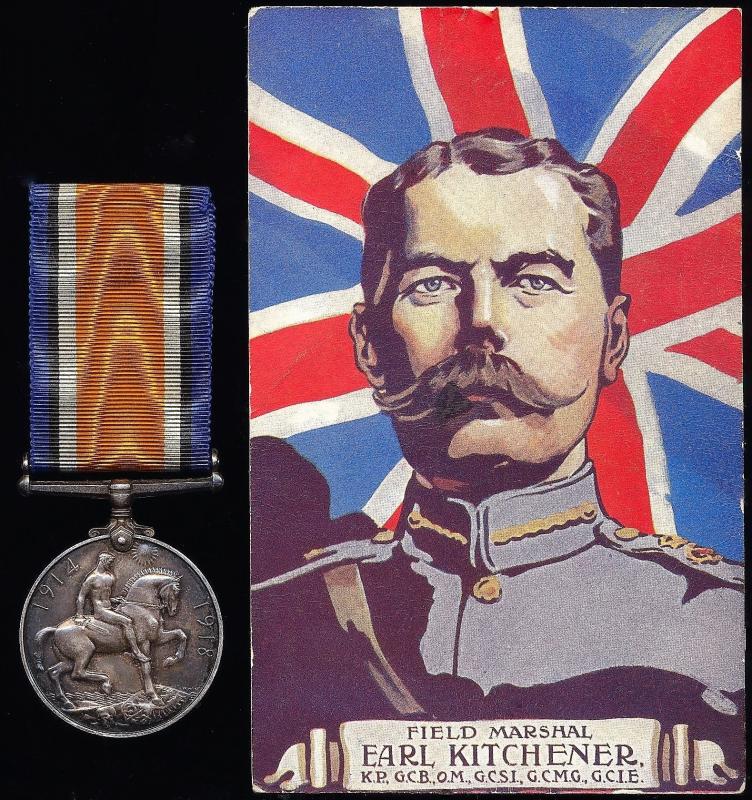
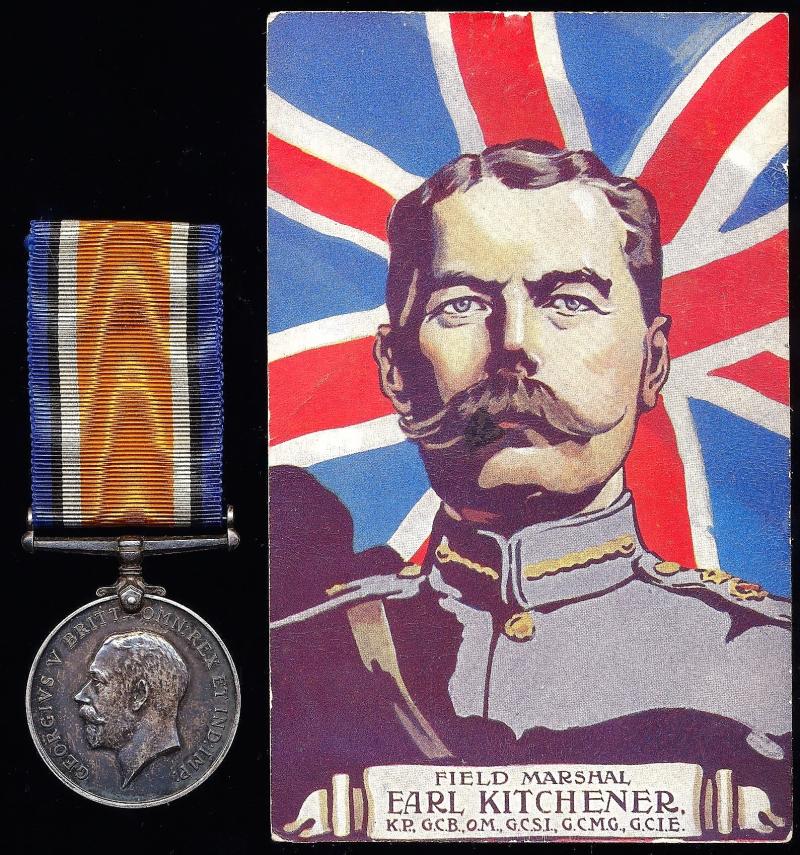
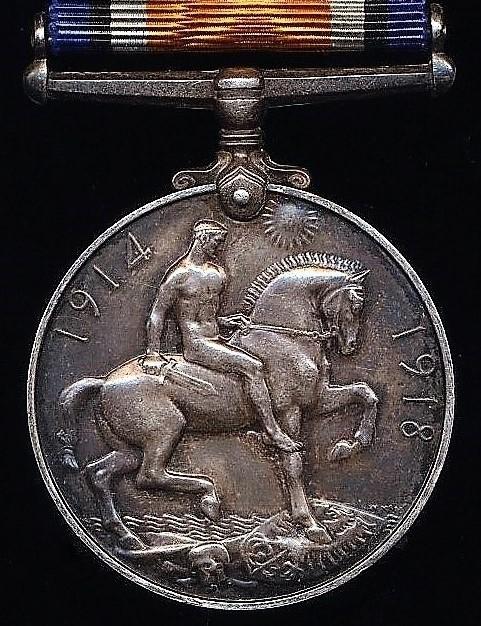
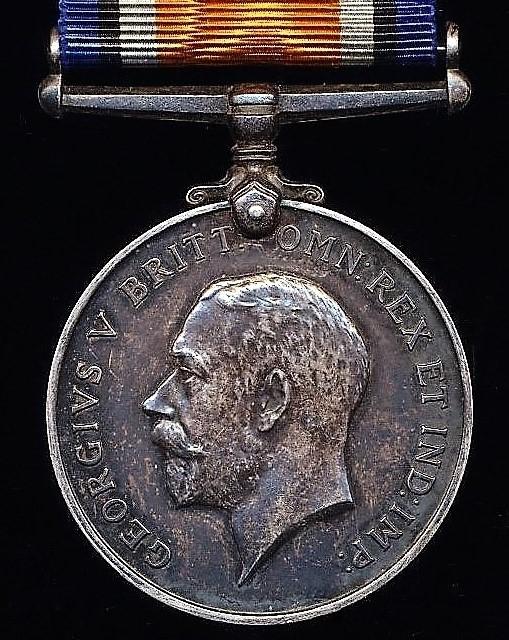
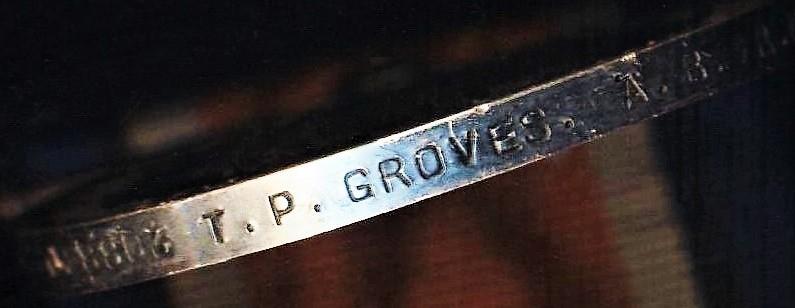
British War Medal. Silver issue (J. 8803 T. P. Groves. A.B. R.N.)
Killed-in-Action: Able Seaman Thomas Percy Groves is confirmed Killed-in-Action, 1916, on the occasion of destruction & sinking of the Battleship H.M.S. Hampshire, which capital ship was carrying Field Marshal Earl Kitchener and his Staff to Russia, and who also was killed in the same devastating sinking, with the loss killed / drowned 737 x souls, with only 12 crew surviving the sinking!
The Last Voyage of H.M.S. Hampshire: After the Battle of Jutland, H.M.S. Hampshire was ordered to carry Field Marshal Early Kitchener and his Staff from Scapa Flow on a diplomatic mission to Russia. Due to severe storm conditions, it was decided that Hampshire would sail through the Pentland Firth, then turn north along the western coast of the Orkney Islands. This course would provide a lee from the strong winds, allowing escorting destroyers to keep pace with her. Hampshire departed Scapa Flow at 16:45 and about an hour later rendezvoused with her two escorts, the Acasta-class destroyers Unity and Victor. As the ships turned to the north-west, the gale increased and shifted direction so that the ships were facing it head on. This caused the destroyers to fall behind Hampshire. As it was considered unlikely that enemy submarines would be active in such conditions, Hampshire's Captain Savill ordered Unity and Victor to return to Scapa Flow. Sailing alone in heavy seas, Hampshire was approximately 1.5 miles off the mainland of Orkney between Brough of Birsay and Marwick Head at 19:40 on 5 June when an explosion occurred and she heeled to starboard. She had struck one of several mines laid by the German minelaying submarine U-75 on 28–29 May, just before the Battle of Jutland. The detonation had holed the cruiser between bows and bridge, and the lifeboats were smashed against the side of the ship by the heavy seas when they were lowered. About 15 minutes after the explosion, Hampshire sank by the bow. Of the 735 crewmembers and 14 passengers aboard, only 12 crew survived after coming ashore on three Carley floats. A total of 737 were lost, including Kitchener and all the members of the mission to Russia
Footnote to Sinking of H.M.S. Hampshire: Fritz Joubert Duquesne – a Boer and German spy – claimed to have assumed the identity of Russian Count Boris Zakrevsky and joined Kitchener in Scotland. Duquesne supposedly signalled a German U-boat shortly after departing Scapa Flow to alert them that Kitchener's ship was approaching. He was then rescued by the submarine as Hampshire sank. In the 1930s and 1940s, he ran the Duquesne Spy Ring and was captured by the FBI along with 32 other Nazi agents in the largest espionage conviction in U.S. history
Thomas Percy Groves, eldest son of Thomas Groves (Farm Labourer) and Emily Matilda Groves (nee Stokes) was a native of White Waltham, Berkshire, England, where he was born on, 4 December 1892. Thomas joined the Royal Navy on 23 June 1910, at which time he is shown as having been prior employed as a 'Horse Boy'. Amongst the ships / bases he mustered aboard prior to the Great War War were; H.M.S. Antrim, H.M.S.Prince George, H.M.S. Achilles, H.M.S. Europa and H.M.S. Doris. His last posting was to H.M.S. Hampshire, that he joined on 4 March 1914 - and was still serving with the Armoured Cruiser when she was destroyed and sunk on, 5 June 1916
A very desirable Naval medal with direct associations with Britain's most famous senior soldier of the Great War era, vis Field Marshal Earl Kitchener
Condition: Dark toned EF
Code: 26220