


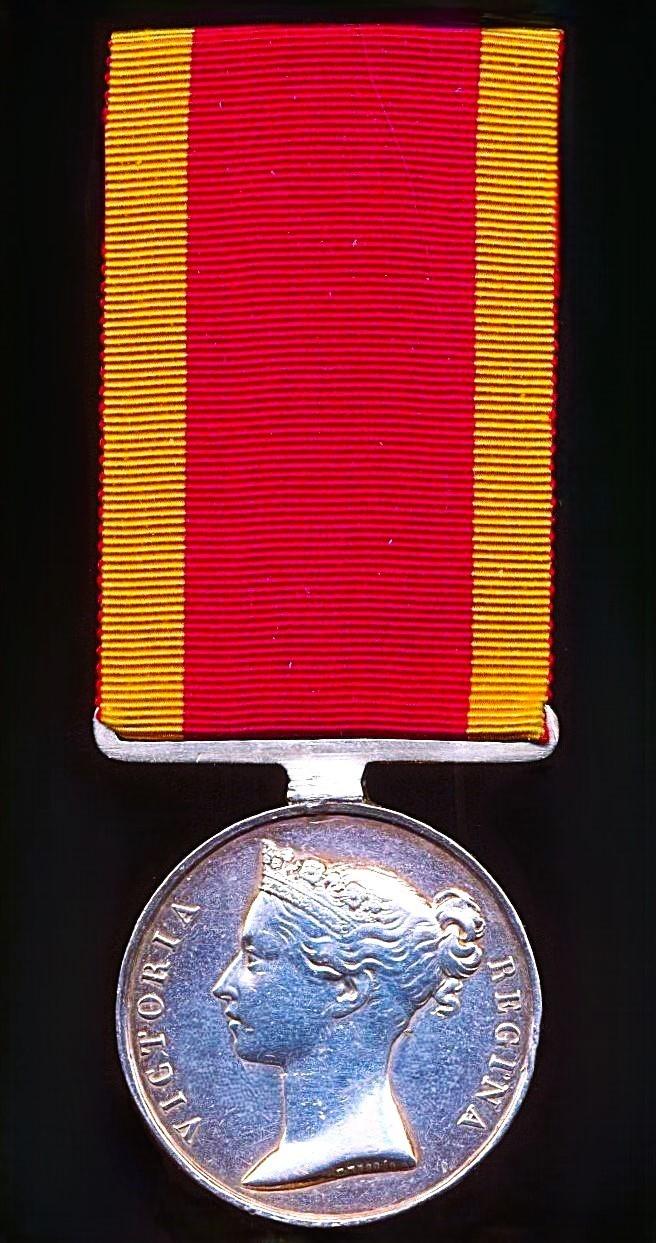
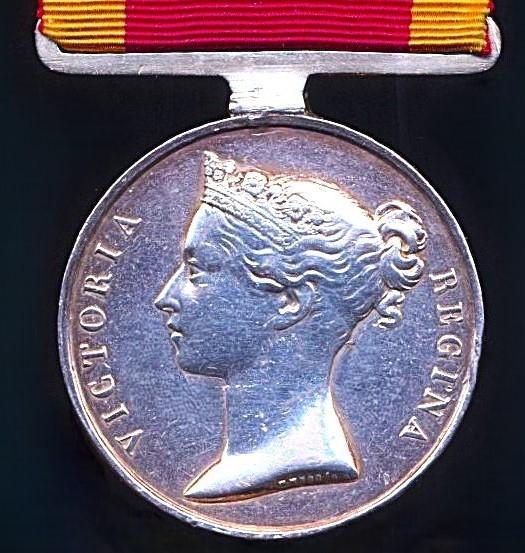
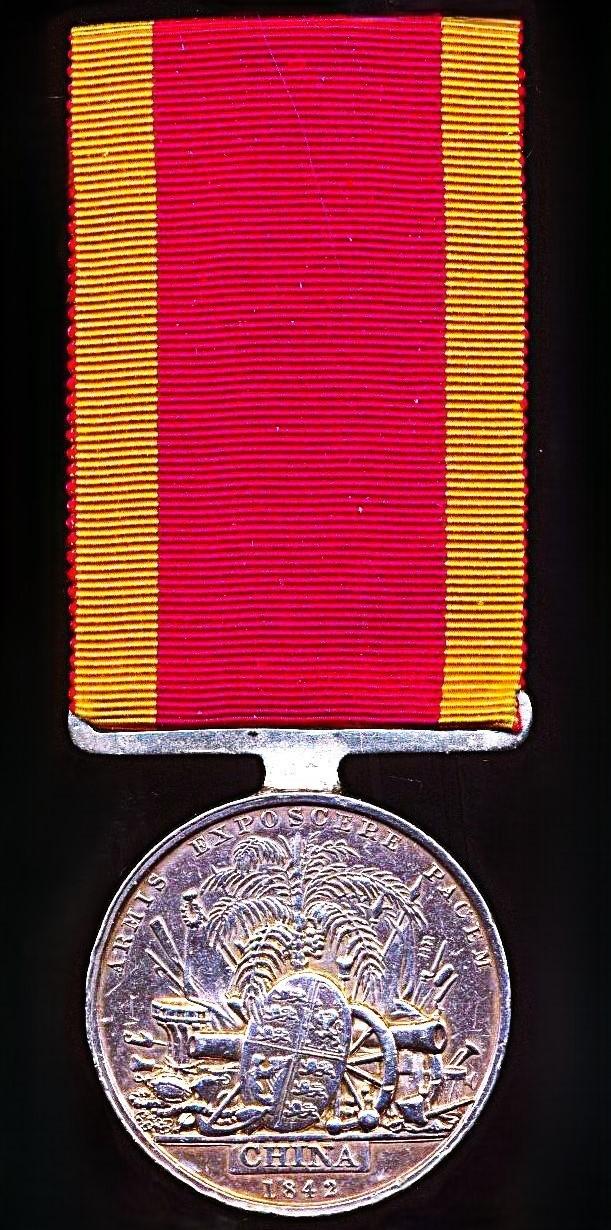
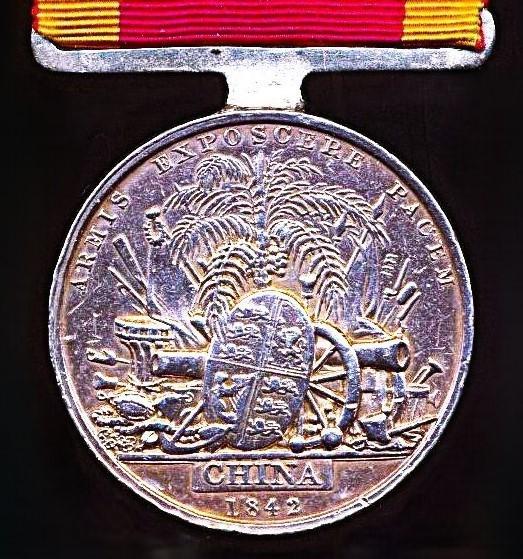
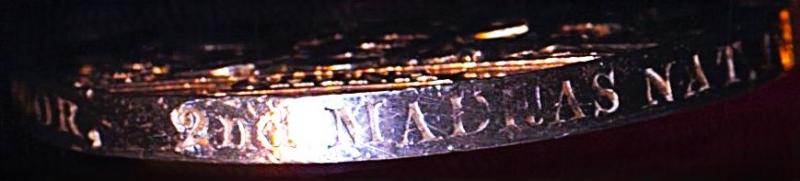
China Medal 1842 (*Syud Guffoor, 2nd Madras Nat. Infantry.*)
The silver medal retaining it's original straight nickel suspension
The medal with officially impressed naming, in the same distinctive style as that used for the Waterloo Medal. The naming taking up almost the entirety of the rim, together with the customary 'Stars' indented before and after the naming
The recipient Syud Guffoor, a Carnatic Mussalman who held the rank of 'Sepoy' (Private) was serving with the 2nd Madras Native Infantry Regiment of the Honourable East India Company's Madras Presidency Army
2nd Madras Native Infantry: The regiment has raised in 1759, at which time it was styled 3rd Battalion Coast Sepoys, of the H.E.I.C. Madras Army. The unit fought French colonial forces in India during the Seven Years War (1756-1763) and later gave service in the 2nd Mysore War (1780-1784); for those early services the unit received battle honours 'Carnatic' & 'Mysore' respectively. In 1796 , the unit was designated the 1st Battalion, 2nd Regiment of Madras Native Infantry. 2/MNI subsequently fought in the 2nd Mahratta War (1803-1805), under the higher command of Arthur Wellesley, the future Duke of Wellington, a famous 'Sepoy General' before he earned the moniker 'The Iron Duke'. For it's services in the 2nd Mahratta War, the regiment was rewarded with the distinction of the 'Elephant' insignia and the two battle honours for 'Assaye' & 'Nagpore'
The regiment became the 2nd Regiment of Madras Native Infantry in 1824 and fought in the 1st China War (1839-1842) - the 'First Opium War'. In China the 2nd Madrasis were one of seven Madras Army infantry units (including the Madras Rifles) that fought overseas in China during the Opium War, where 2/MNI served in the 2nd Brigade under Major-General James Schoedde and was instrumental in the British victory at the Battle of Chin-kiang-foo (Chinkiang) on 21 July 1842. For their collective good services in the Opium War the regiment was awarded the special 'Golden Dragon' with the 'Imperial Crown' insignia together with the battle honour 'China'
Reference 'Madras Native Infantry 1748-1943' (Pythina-Adams, Madras 1943), the author gives below details on the unit's service in China:
Quote,
The 2nd and 6th M.I. took a notable part in the capture of Chin-Kiang-Foo on July 20th, 1842. In company with the 55th Foot they escaladed the walls under a heavy fire of round and grape shot, cleared the ramparts at the point of the bayonet in the face of stubborn resistance and under an intense fire from the houses below, and then threw open the gates to admit the remainder of the force, when enemy resistance soon ceased.
The 2nd M.I. remained as part of the Chusan Field Force after peace had been signed on August 29th, 1842, and did not return to Madras till June 1845.
Unquote.
A very scarce seen example of a China Medal for the 1st Opium War, named to an Indian soldier of the Madras Army
Condition: VF
Code: 25955