


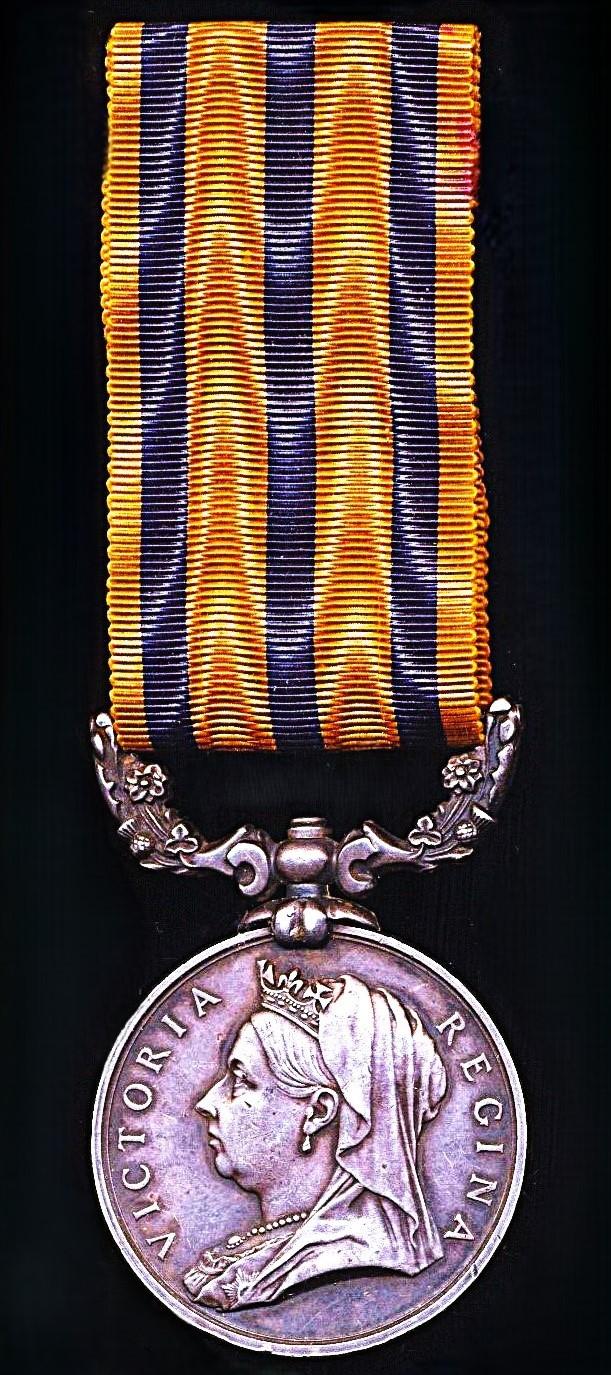
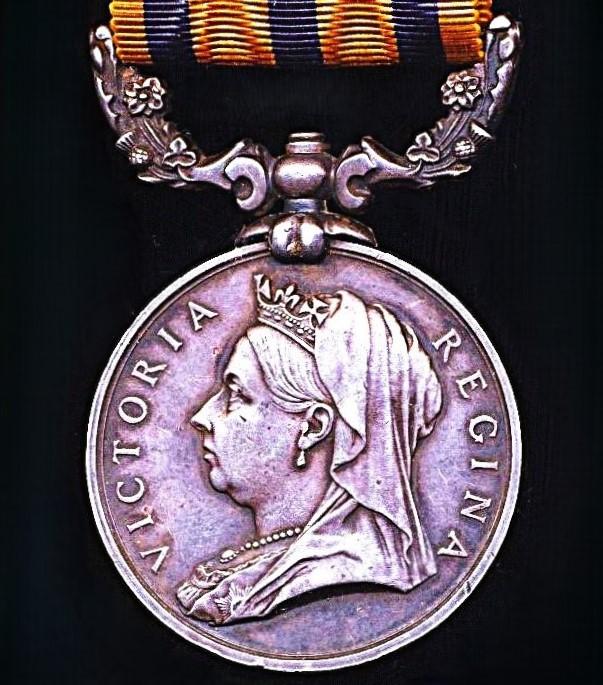
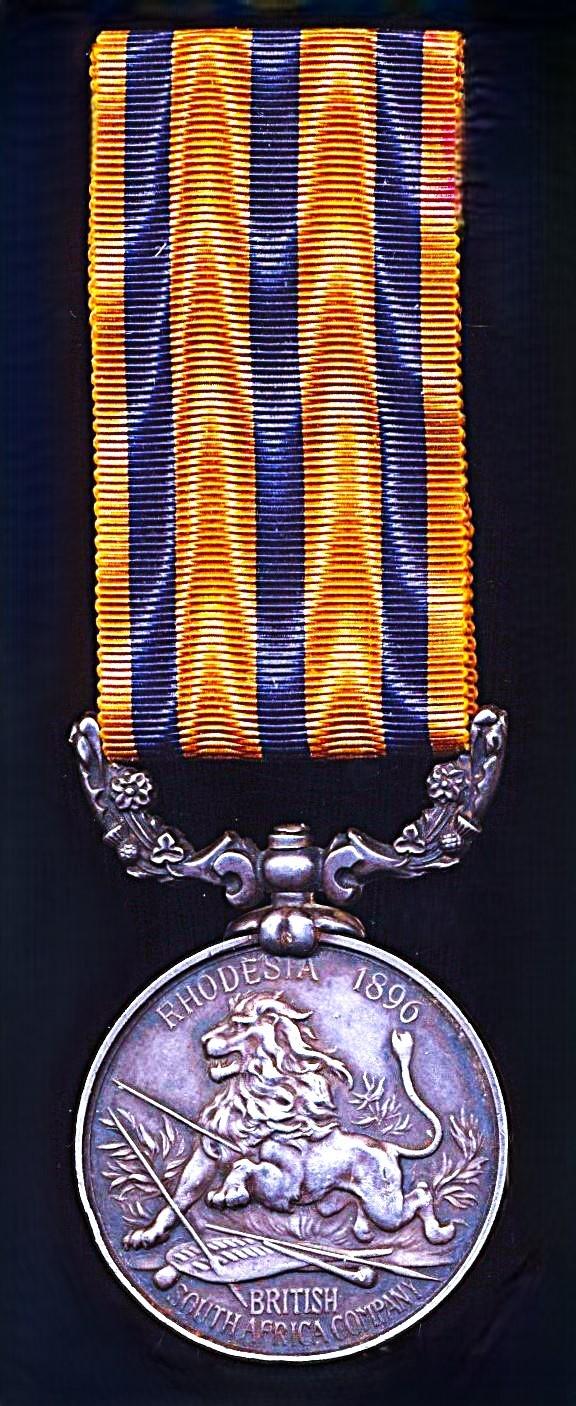
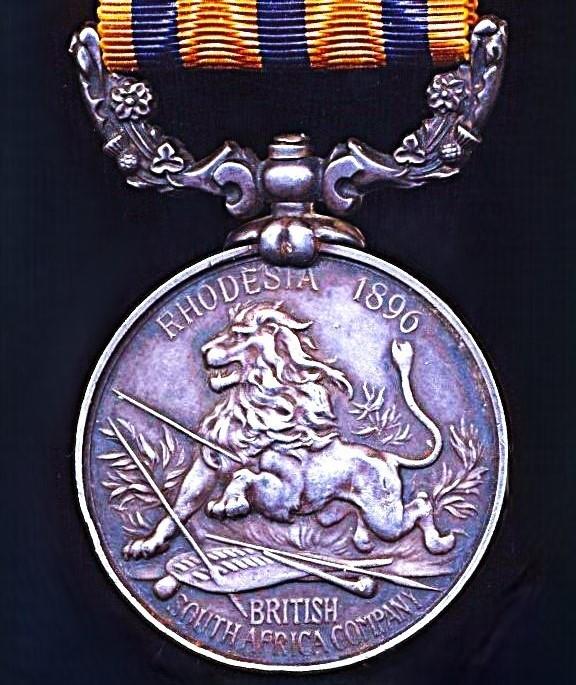
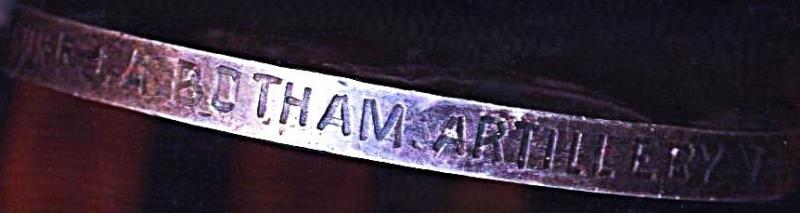
British South Africa Company Medal 1890-97. With 'Rhodesia 1896', no clasp (Gunr. J. A. Botham. Artillery Troop B.F.F.)
The rank 'Gunner', denoting he was a member of one of the gun teams of the Artillery Troop Bulawayo Field Force
Important: Medal entitlement confirmed per the respective campaign medal roll (ref WO 100/77)
Reference 'British Battles and Medals' (7th Edition, 2006) it is estimated that 140 x BSA medals with 'Rhodesia 1896' reverse were awarded to men serving in the Artillery Troop of the Bulawayo Field Force - a force totalling about 650 all-ranks, and comprised various sub-units
On 11 May, 1896, a column of about 42 officers and 613 men of the Bulawayo Field Force commanded by Colonel William Napier set out from Bulawayo with the object of opening the road to the Tchangani River where it was hoped to meet up with the relief column from Salisbury under Colonel Beal. Colonel Napier's force include a detachment of the Artillery Tropp that comprised; 4 x officers and 34 men under Captain Biscoe. They were armed with one 7-pounder, one 2.5 gun, one Hotchkiss, one Nordenfeldt and one Maxim-Gun
Whether Gunner Botham was one of the Artillery Tropp to take part in Colonel Napier's column is not known. What is known with more certainty is that GunnerJohn Andrew Botham survived the 1896 Rebellion, as he is recorded returning to his family in Brighton, England, where he arrived in 1899
Victoria Column - very few of which would have been awarded to the small group of men who were gunners handling the 6 x Maxim Guns or 2 x 9 x Pounder Artillery pieces.
On his return from colonial pioneering and campaign service in Rhodesia, Botham found himself a minor celebrity, in Brighton, Sussex, England, vis his subsequent receipt of the campaign medal here offered, being reported in the local Sussex newspapers. The artcile pertaining to he award of the medal was published in the 'Southern Weekly News; issue of 6 May 1899:
THE MATABELE WAR
Honour for a Brighton Man
Gunner J.A. Botham, who was a member of the Artillery Troop of the Bechuanaland (sic) Field Force, and served in the interests of the Chartered Company in the Rhodesia War in 1896, had a very pleasant, and at the same time much deserved surprise on Wednesday. By the first post he received a medal in recognition of his services in the field. Gunner Botham, who has many friends in Brighton, and who is staying with his brother, Mr. Clayton Botham, will receive the hearty congratulations of many friends on the well merited trophy which he has just received. He went through the campaign without a scratch, and his arrival in Brighton some time since was the cause of much rejoicing among a large circle of friends.
Unquote.
As a 'Gunner', presumably the recipient was part of one of the Maxim Guns teams - or rarer, a Gunner on one of the 7 x Pounders - modern weaponry which in the hands of relatively few colonial's, proved the decisive weapons throughout the various Rhodesian campaigns of the late 19th century
It was the apaling loss of life incurred by the Matabele at Shangani (estimated at 1,500 dead against the loss of only 4 x Europeans) and at Bembesi (2,500 dead for the loss of 4 x Europeans killed & died of wounds) that the Belgian-British writer and poet, will be remembered in perpetuity for his quote;
Quote,
Whatever happens, we have got
The Maxim Gun, and they have not
Unquote.
A more contemporary Rhodesiana reference to the use of Maxim Guns, are the below lyrics words from the 'Troopie' song 'Battle of Bembezi' by songster John Edmond;
Quote,
And near 6000 warriors - we stopped them on the run
The bravest of the brave could never match the Maxim Gun
Unquote.
To hear John's song, in full access cut & paste below link into your search engine:
https://www.youtube.com/watch?v=IonNtFYvd4E&list=RDIonNtFYvd4E&start_radio=1
John Andrew Botham, son of Benjamin W. Botham (Music Hall Proprietor) and Ellen Botham (nee Bedwell) was a native of, Halesworth, Sussex, England, where he was born circa 1860
Apart from his Colonial Pioneering experience in Rhodesia circa 1895-1899, he spent most of his life associated with Music Hall and Variety enterprises, a legacy of his parents, who were well known in the Brighton music hall music hall entertainment scene. Indeed, when a young man and assistant to his mother, his widowed mother was financially ruined in the wake of a sensational entertainment stunt - that was reported widely in the United Kingdom - when the star-act went badly long. 'Ah Ling Look, Chinaman and his wife Caroline' together with John's mother, were held prisoners during the trial later being released on bail. The freak accident occurred when Caroline Ling Look, having fired a cannon, that decapitated a young boy 'George Smythe' a witness to the fatal accident shouted 'His head is shot off'. Reference the Brighton Standard newspaper issue of 7 January 1882'
John Andrew Botham, never married. He ran the Oxford Music Hall in Brighton until about 1891. In 1893 he was the Head of the Empire Theatre of Varieties and in 1894 he was the General Manager of the Eden Theatre of Varieties. John Botham,, is recorded to have died sometime during the last quarter of 1932, when his death was registered in Croydon, Surrey, England
A most interesting and desirable Rhodesia Medal to a Brighton man
Condition: GVF
Code: 25950
495.00 GBP