


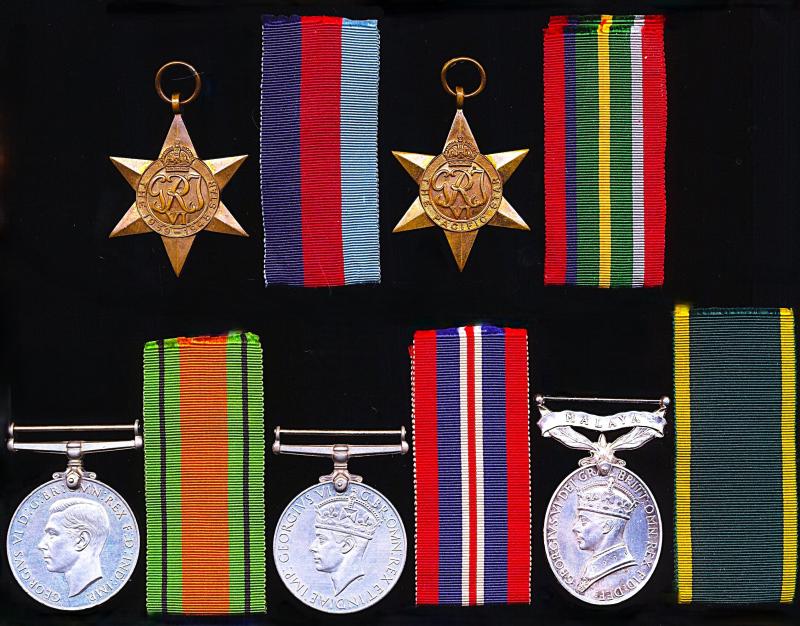
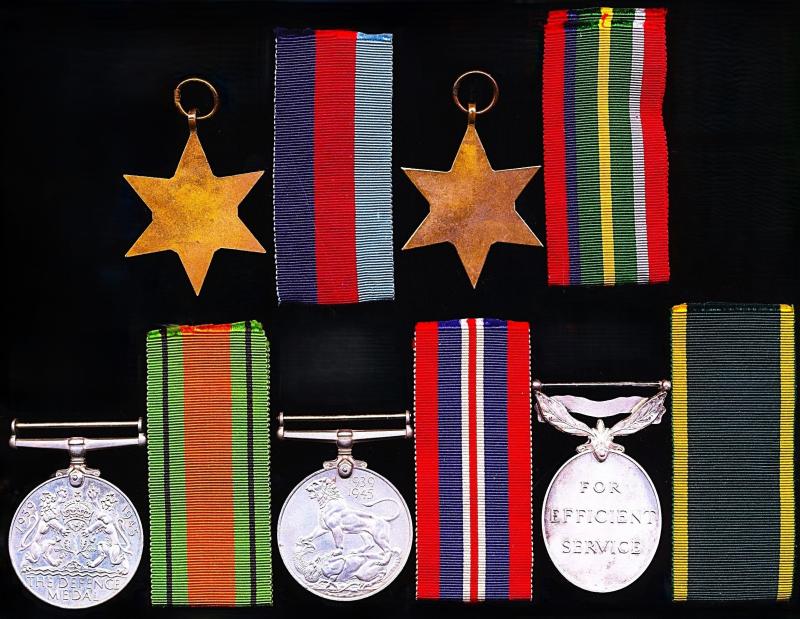

An extremely scarce Coventry 'Rubber Technologist' & Malayan Volunteer Far East East Prisoner of War campaign & long service medal group of 5: Sapper Thomas Henry Barnwell, Johore Volunteer Engineers, late Dunlop Rubber Company
- The 1939-45 Star
- The Pacific Star
- Defence Medal
- War Medal
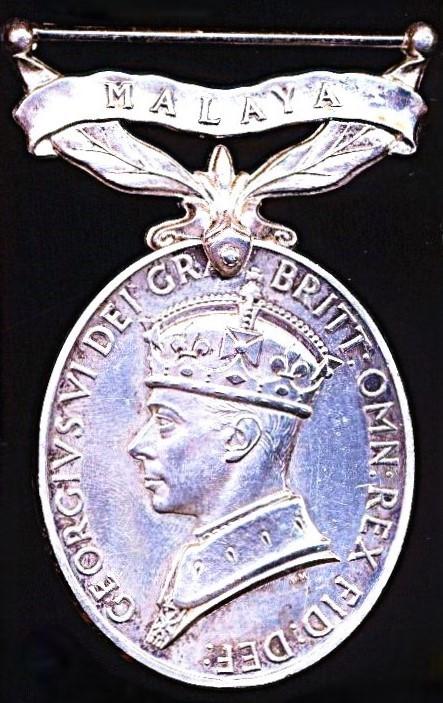
- Efficiency Medal. GVI second issue 'Malaya' (848 Sapper Thomas H. Barnwell, J.V.E.)
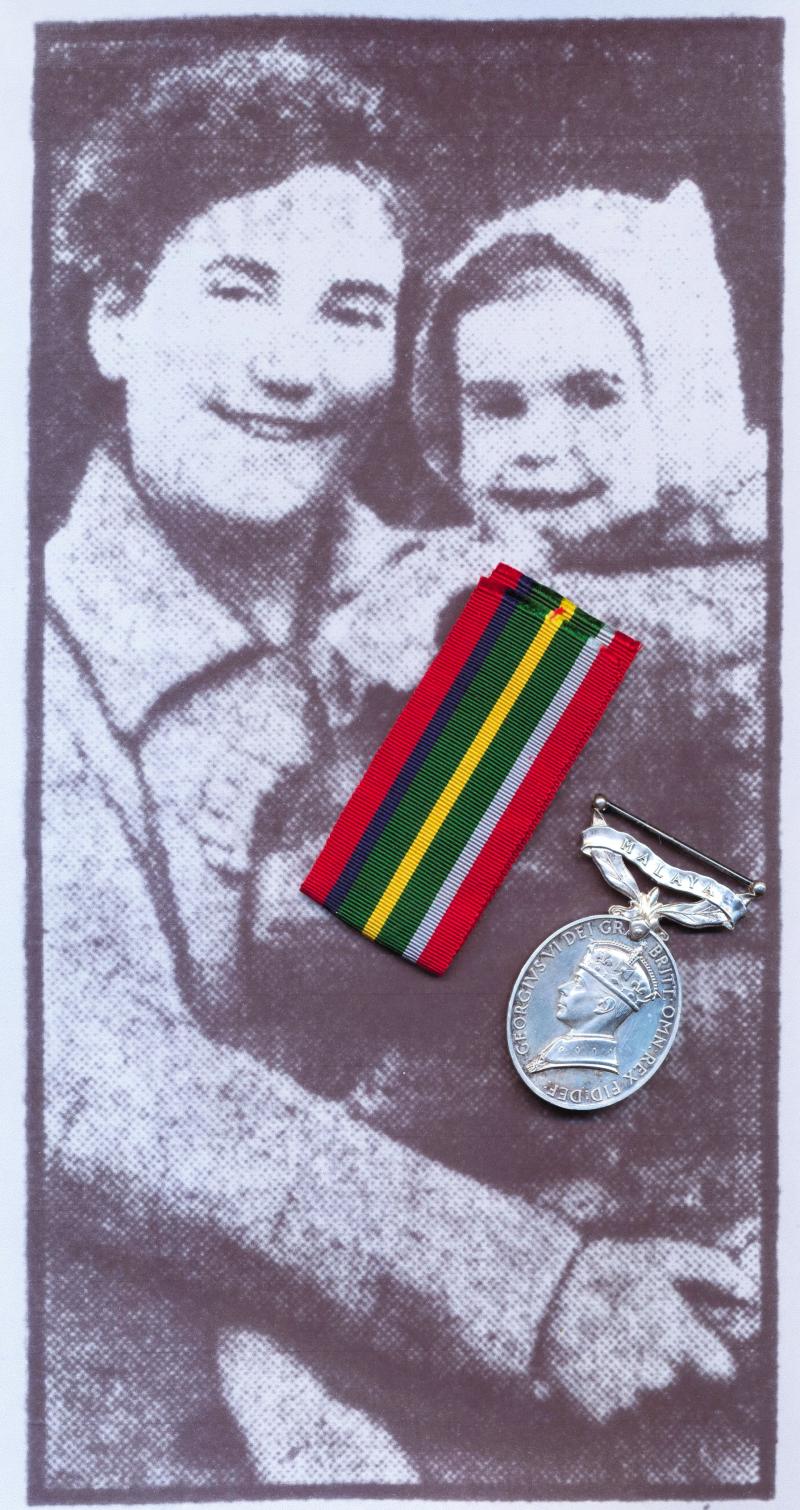
Photograph of Recipient: A named wedding-photograph of the recipient (together with his bride) was published in the Birmingham Gazette issue of, 9 March 1937
Medals Verification: Second World War medal rolls for Far East colonial units are not accessible in the public domain However, basis confirmation of recipients residency & subsequent service in Malaya, the recipients entitlement to all 1939-45 medals is confirmed per the award criteria (WO Code No 1911 'Campaign Stars and Commemorative Medals Instituted for the 1939-45 War (The War Office 11 June 1948)). The Efficiency Medal is confirmed per the below cited primary source:
- The 1939-45 Star: Awarded for 1 day service in theatre from 8 December 1941
- The Pacific Star: Awarded for 1 day service in theatre from 8 December 1941
- Defence Medal: Awarded for 1 year service in theatre from 3 September 1939 to 7 December 1941
- War Medal: Awarded for 28 days service
- Efficiency Medal. GVI type II 'Malaya': Published Federated Malay Government Gazette 13 April 1950
Thomas Henry Barnwell, son of Joseph Barnwell (a Tramcar Conductor) and Annie Elizabeth Barnwell (nee Clarke), was a native of Coventry, Warwickshire, England, where he was born on, 18 February 1911. In 1937, Thomas, described in 1941 as a 'Rubber Technologist' (also Latex Chemist) accepted an appointment with the Dunlop Rubber Company, in Johire State, one of the un-federated Malay States in Malaya, where he was based at Fort Dunlop! In England the pre-war family home was located at, 56 Rosary Road, Erdington, Birmingham. Peter evidently had a most interesting childhood and early working career, as passenger records, show that he journeyed several times to/from Uruguay , Argentina and Brazil in the early 1920?s. By profession an Engineer, he worked as a ?Planter? in the Federated Malay States, where he was employed by ?Guthries? as a Manager at the Kahang Estate, Kluang, Johore. Thomas was a pre-Pacific War member of the Johore Volunteer Engineers, or J.V.E. in which unit he held the regimental number No. 48 & rank of Sapper. Once mobilized he served on active service in 'Malaya' theatre, 08/12/41 - 15/02/42. Captured at Singapore Colony on 15 February 1942. Sapper Barnwell's extant POW Liberation Questionnaire (held & accessible at The National Archives) records his incarceration history as:
- Singapore (Changi): 17/02/1942 - 05/05/1942 (note the incarceration date 2 days after 'Surrender')
- Singapore (Adam Road): 05/05/1942 - 29/06/1942
- Thailand (Various Camps Railroad Construction): 11/1942 - 06/1944 (note long transit ex Singapore)
- Japan (Amagasaki): 09/1944 - 06/1945 (Note long transit between leaving Thailand & arrival in Japan)
- Japan (Toyama): 06/1945 - 09/1945
During his years of captivity in Thailand 'He did much good medical work Thai Camps' (In Oriente Primus A History of the Volunteer Forces in Malaya & Singapore' (Moffatt & Riches, 2010 ), refers)
After liberation in 1945, Thomas returned to his family in the United Kingdom where he was reunited with his wife and daughter, and where he remained for some months before returning to his pre-war appointment in Malaya. Thomas Henry Barnwell latterly of Sutton Coldfield is recorded to have died in England on, 31 January 1969.
Often overlooked / neglected, the fate of the civilians and families of the pre-war British expatriate communities who lived and worked in Malaya (now Malaysia) & Singapore and neighbouring territories is equally gripping, in terms of their fates, with very few of them avoiding capture and incarceration. Amongst the few 'Lucky Ones' to be evacuated successfully immediately prior to the surrender of 'Fotress Singapore' was the wife Noreen Barnwell, and the toddler daughter, Valerie Barnwell, of Thomas Barnwell. The gripping tale of the mother & daughter voyage(s) from Singapore (they had left on the 'Empress of Japan' bound for Western Australia, and then on to Liverpool, England via Cape Town - was captured for posterity together with a poignant photograph of the pair in the 'Evening Despatch' newspaper issue of, 11 April 1942:
Quote.
- Birmingham woman tells of nightmare escape from Singapore
Back in Birmingham after escaping from Singapore with her baby daughter, Valerie, is Mrs, J. Barnwell. She only had 15 minutes warning to prepare for her hurried and exciting departure.
Five years ago, as a bride, she left Birmingham to go with her husband to Johore, where he was taking up a post as a research chemist. She got married at 11 days' notice.
She had to leave her husband behind in Singapore, where he was serving with the Johore Volunteer Engineers of the Australian Auxiliary Force (sic) Force.
No news has come through since she left him nine weeks ago to join her parents. Mr. and Mrs. Taylor, of 56 Rosary-road, Erdington. But now she hopes he, too, has escaped to fight again in Australia
Before the trouble started in Johore Mr. Barnwell sent his wife to friends in Singapore. When he heard rumours that women and children were being evacuated he got leave from his unit to say goodbye to his wife.
- On the boat.
It took him hours to trace her in the raided city, but eventually he found her on the boat, half-an-hour before it sailed.
In Singapore she and two year old Valerie had lived through constant bombardments. At first only women with two or more children were allowed to leave. Then, at 15 minutes' notice, she was told to report for a berth. Two thousand people were crammed into the boat. Some slept seven in a cabin, others side by side on the deck.
- Terrible days.
Although she had only a few cloths, and a little jewelry, Mrs. Barnwell found herself much more fortunate than many of the other women. Many of them had lost all track of their husbands, and one had lost her little girl in the headlong flight for safety.
Every man up to 44 in the island had been called up for service within the last month, and it was difficult to maintain any contact. Constant air-raids added to the confusion.
"It was a shame that the evacuation of women and children did not take place much sooner," said Mrs. Barnwell. "The last days were terrible. Valerie had to go to the shelter, while I tried to pack a few of our belongings.
"Five bombs fell close to our house. All the time Japanese formations seemed to fly overhead, but we rarely saw one of our fighters. I think that was the reason we failed to hold the island. Confidence seemed to go. But I am sure once we tackle the Japanese properly, we shall soon have them beaten."
Now, wearing borrowed clothes, she waits daily for news of her husband. "Somehow, I feel sure that he is safe, and that somehow he managed to get away," she told me.
But the nightmare journey on the dive-bombed, crowded liner has taken its toll. Valerie contracted pneumonia, and Mrs. Barnwell has had a severe attack of bronchitis.
And little Valerie is still frightened when she hears the roar of a train or anything that suggests to her the sound of an areoplane.
DOREEN RICKARD
Unquote.
Johore Volunteer Engineers: The unit was formed in 1928, with an establishment of 258 all-ranks. They were one of the very few all-European Volunteer units raised and domiciled in the Un-Federated Malay States. The unit was mobilized and deployed as 'Field Engineers' during the Malaya campaign 1941-1942
Fortuitously there are a number of privately published memoirs / articles on this unit and its war services, for example see the scarce (not recorded in Perkins bibliography 'Regiments') see the 16 x page re-printed history pamphlet of the Johore Volunteer Engineers, sometime published in the R.E. Journal - that copy heavily annotated in the margins with handwritten notes. Other excellent sources for details on the Johore Volunteer Engineers, are the detailed memoir by Guy Hutchinson J.V.E. titled 'The rhinoceros of Johore' that can be downloaded from the internet, as well as accessing the superb audio recordings of John Hedley, a former member of the J.V.E. later attached to the Mysore State Infantry held and accessible at The Imperial War Museum
A rare and desirable EM 'Malaya' group to a member of the Johore Volunteer Engineers
Condition: About EF
Code: 25864