


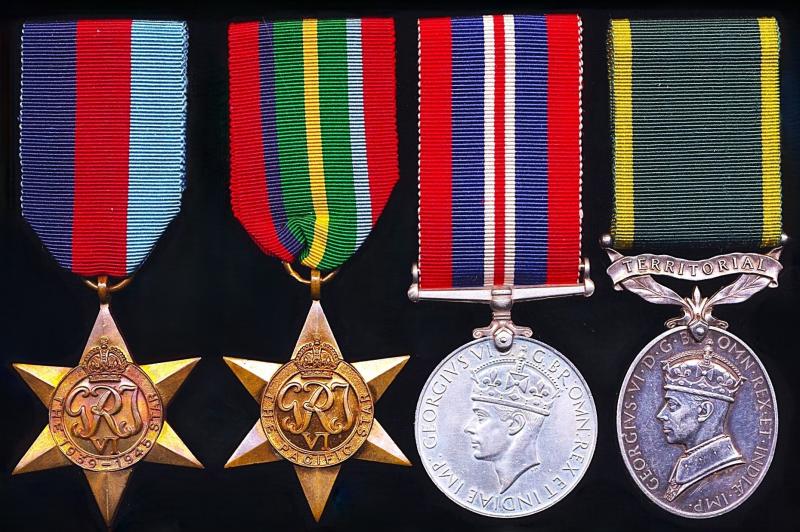
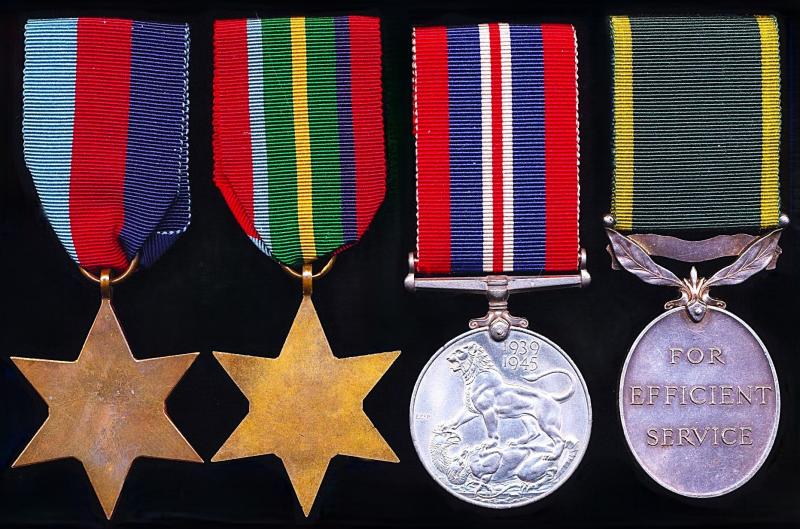
An epic 'Wigan to Fukuoka' FEPOW Hell-Ship medal group of 4 - Survivor of the sinking of the Hofuku Maru, whose eye-witness account helped secure a death sentence for a War Criminal: Sergeant James Winstanley 5th Bn Bedfordshire & Hertfordshire Regiment
Sergeant James Winstanley, who was taken Prisoner-of-War at the fall of Singapore Colony, 15 February 1942. For 2 years he worked on the Burma-Siam 'Death' Railway. In July 1944, he was then selected for transportation to Japan, and miraculously survived the Japanese ‘Hell Ship’ Hofuku Maru that was sunk by aerial torpedoes dropped by United States Navy aircraft on 21 September 1944, on which date 1,047 Allied prisoners of war lost their lives.
So there be no grey area in the terror and harrowing ordeal that Sergeant Winstanley. endured when the 'Hell-Ship' he was aboard was hit and sunk within minutes, with the loss of over 1000 British and Dutch FEPOW's, consider the events in his own words (below) - that Sergeant Winstanley, had to cast to his death a comrade who had clung to him, and imperilled his very own survival - and who only minutes later while floating amongst the flotsam, sought his Officer's 'permission' to attempt to drown the Japanese Staff Sergeant Jotani, who was spotted alive in the water........
Lucky to survive, he was subsequently detained in Manila, Philippines, before proceeding on a further odyssey of transportation via Hong Kong, Taiwan, Korea for ultimate destination Japan. His odyssey from Thailand, to Singapore, Miri (Indonesia), Manila, Hong Kong, Taiwan to Japan took over 4 months of hellish endurance. Fortuitously, Sergeant Winstanley, contributed a 5 x page statement used in the subsequent 'Singapore War Crimes Tribunal' case against Sergeant Jotani, who had been in charge of the British POW's aboard the 'Hofuku Maru'. Jotani was in due course found guilty of 'War Crimes' and was sentenced to death by hanging, that was carried out at Changi Gaol, Singapore Colony, in 1947
- 1939-45 Star. No clasp
- Pacific Star. No clasp
- War Medal
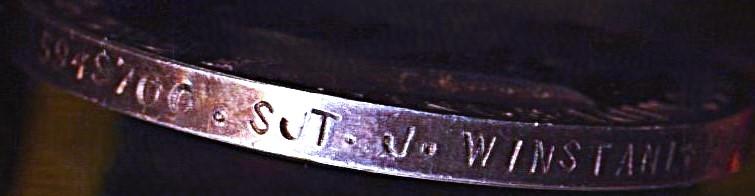
- Efficiency Medal. GVI first issue with 'Territorial' bar (5949700 SJT. J. Winstanley. Bedfs & Herts.)
Medals Verification: None of the medal rolls for any of the recipients medals are accessible in the public domain. The recipients, entitlement to all 4 x medals is however confirmed basis the recipient's enlistment and place of capture dates per below cited primary sources:
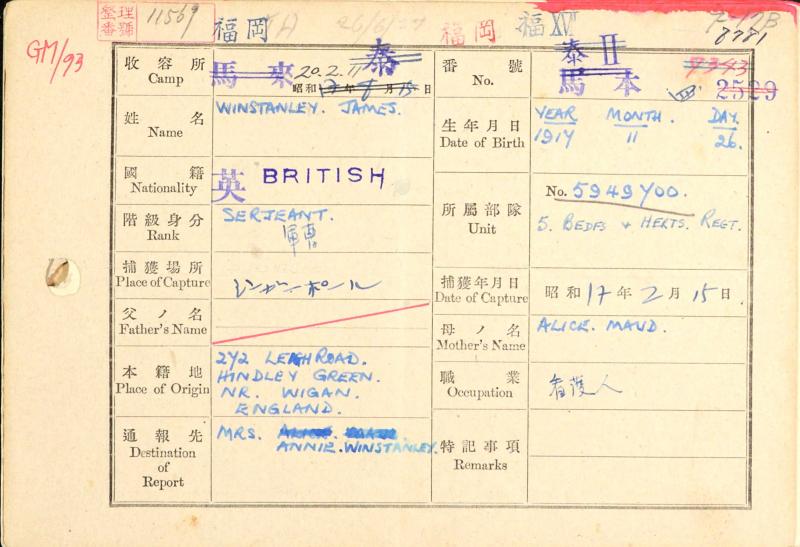
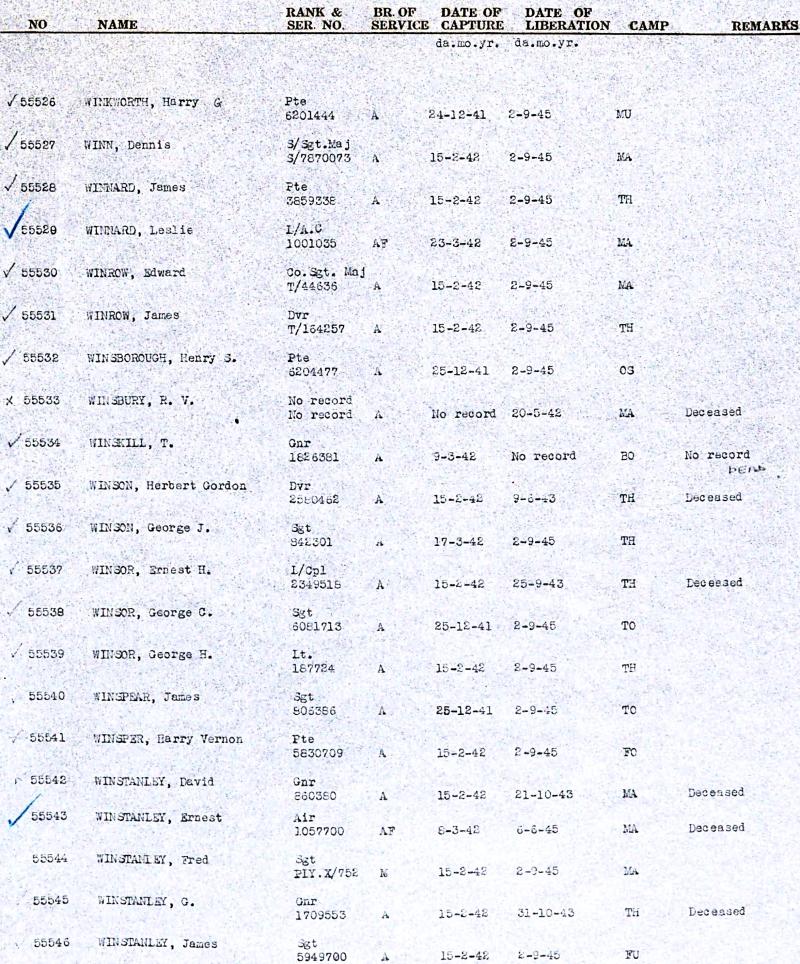
- 1939-45 Star. No clasp: For 1 day in theatre. Recipients Japanese POW Card confirms service
- Pacific Star. No clasp: For 1 day in theatre. Recipients Japanese POW Card confirms service
- War Medal: Automatic qualification on completion of 28 days aggregated uniformed service 1939-1945
- Efficiency Medal: 12 years service, war service counting double (served TA 1939-45)
The recipients unique Army Number was from the block 5942001-5998000 awarded to the Bedfordshire and Hertfordshire Regiment Royal Engineers in 1920, and issued sequentially thereafter to new enlistees to the regiment between 1920-1941
Reference the National Archives WO361/758 File Series for Sergeant Winstanley's long statement, that with minor typographical editing - and removing the name of the comrade who was cast to his death 'X'' is presented below:
QUOTE,
We left Thailand on June 6th 1944 and as a P.O.W. we all thought we were going to better ourselves, in such as food and living conditions, but time proved that we were sadly mistaken.
I can always remember before we left Chungkai how all men of the 5th Bedfs assembled one night and had a chat over a drink of the coffee that the P.R.I used to sell out there. Then on the day we moved all our Unit that was due to leave for Japan was given the (dope) news from Major Robinson. June 6th the day that France was invaded, but we were not to know then. I saw Capt Wormleighton who was then in the hospital with fever and an ulcer.
Well we were pushed in to the cattle vans as was the custom of travelling with the Japs. I think 38 men to one van and it took us four days to reach Singapore. We were billeted in Havelock Road Camp on the smallest of rice rations for just over two weeks, all the men at that time were pretty fit considering, apart from the fever. I was in 69 Party, O/C was than Capt Evans of the Manchesters, CSM Kerr of the Cambs and myself was acting CQMS, most parties consisting of 150 personnel.
On the morning of June 27th we marched to the docks and boarded a Jap ahip called Hopkuku Maru, about 10,000 tons, 1,250 men were crammed on, 600 men in each of the holds alloted to us.
We were given two meals a day, water was scarce for drinking, although the Japs could drink and clean their teeth in it. After one day in dock we set sail to our sorrow. Nothing did happen till we got to Manilla, only that most of us had been suffering from Beri Beri of some description, such as blindness, loss of memory and unable to walk and internal pelagra
During all the voyage all the officers such as Capt Evans, Capt Dean of the Cambs,. tried their utmost to purchase or steal from the Japs better food but it was of no avail until we called at Borneo, but still no improvement in the food. Breakfast on the first meal was just plain rice boiled as a porridge, tea was made out of salt water, the second meal was boiled rice again with a tablespoon of vegetable and perhaps one ladle of soup from the vegetables. The veg. comprised of potato tops, pumpkin leaves, it was a headache for the one to issue it out.
We were a mixed company and nearly a few of every Unit were present including 250 Dutch. The Jap sergeant in Charge was mad and treated us shockingly. Dr Lewis was our doctor nearly all the way and did good work under the conditions.
I was at the forward end of the ship with all 69 party, of our Unit there were Sgt Wright of A Coy, Welham & Johnson of D Coy, Karhy, Hayes J, O'Mahony, Peasnall, Edwards, Clarke C.H., Emerton, Heeley, Ives R, Plum, Gilfillan, Hanlon, Mc'Cue, High, Mac'Donald, Burns, Chorlton, Hayward, Ingram, Cpl Hornett, all other Bedfs & Herts were at the other end of the ship with Sgt. Burgess.
On reaching Manilla things were in a bad state we lost Pte Heeley of D Coy who died of Beri-beri, Pte. Nugent of A Coy died of Interior Pelagra, Hands of D Coy died of Beri-beri, Hayes P of D Coy died of Beri-beri. These four men died and were buried at sea. Heeley and Nugent I myself saw to their kit that they left was issued to them by the Japs.
Before we set sail from Manilla on 20th Sept 1944 we buried 99 men at sea, and another 50 men were taken to the hospital at Manilla and left there after a lot of persuading. Now up to the 20th Sept. the Americans had never shown up, either by bombing or by submarines, and all this while we had been having our ballast taken out, and the engines repaired. The natives that is the Phillipinos gave us the news when they could and a good supply of sugar which they themselves stole from a boat alongside of us.
Anyway we carried on, everyday the situation getting worse, rumours of sailing that never seemed to come true. By now everyone had some kind of illness. The hold that we had turned into a hospital was packed full with what we thought was the worse cases, the flies by this having over run the ship. At times we thought of taking the ship in our hands but the chances of getting away were slim. All the men played up to the situation very well, just an odd case here and there where the officers had to step in, some hardly seemed to sleep at all.
We had eight buckets down our hold for latrine purposes, Dr Lewis did some good operations with razor blades and knife such as appendicitus, cases of Beri-beri had their feet cut so as to rid them of some water, and yet most of us had the feeling that that we could not reach Japan on that boat.
Pte Ives R was by then blind and could not walk, Pte x went out of his mind and could hardly walk, Pte Chorlton also could not walk, Pte Lawrence of stretcher bearers was covered with ulcers and could not walk, but before he got in that condition did some very good work. Sgt Johnson and Sgt Wright were just beginning to go down, I myself had Beri-beri in the stomach but it did not keep me off my feet.
Whenever I could help my own men I did such as sugar and other small bits of food that was rationed out under my supervision. It seemed to me to be one long nightmare that had no ending to see men whom I had been with for a few years to suffer like they did, for instance, Pte x all day long would be crying and could not remember anything, if I spoke to him he would break down crying because he thought he was a nuisance.
But our day for sailing came on 20th Sept, everyone on the boat seemed more cheerful and I myself celebrated with a cup of tea, getting the water from under the winches after the steam came through it, it was the best tea that I had had for months.
I woke up the following morning and after getting to know the time from someone, which was 7 a.m. passed the time chatting with the lads around never dreaming that soon we should get a rude awakening. The first half of hold had been fed and I made my way to the deck as was my routine to prepare and bring our rations. Sgt. Shardlow of the Manchesters was doing police duty on top as it was an order from the Japs that no one was allowed on deck, only such as myself and persons on duty. I passed him by and made for the Galley when I heard the heavy drone of planes overhead, at first I paid no attention to them thinking they were Japs again, till one of the planes opened fire and dived towards the convoy.
I estimated over 50 planes and most of them passed over and only a few stayed but they were enough for us. I rushed back down the hold and with the help of the CSM told the men to put on their life jackets, each man had one, the Kapox type and also help the sick with theirs. By this time our ship received a hit at the rear, then the centre of the ship was hit by this time most of the lads realised this was the end of this hell ship then to crown it all we got the next right in our hold caved in, water rushed in throwing the lads down to the bottom.
By this time it was every man for himself. I gave a jump and reached for a beam and just hung on with my fingers. I can remember another fellow doing the same as I had done, and somehow grasping around my waist. I kicked out with my feet and but for the water coming up and flooding the hold and making him release his grip on me I would have met my doom. The next I can remember is asking a fellow for a pull but he had not the strength nor the time. It was then I went down to the bottom with my life jacket still on, next I can recollect is going through the water with my lungs nearly bursting. It seemed ages before I reached the surface, when I did I caught hold of a part of the wreckage and lay on my back for a few minutes for I was foaming at the mouth and I knew it had been a near thing for me.
On looking around for my comrades I was surprised to see that I estimated as only a few, say 200 and a sprinkling of the Jap guards. The first man I saw was O'Mahony whom I joined on his raft, and along with two more fellows, who were sick and could only lie, we tried to row ourselves out of the wreckage.
The Jap serjeant, that was supposed to be in charge of us, was very close to me with his full kit including his sword. I called to Capt Evans to see whether I should make an attempt to drown him, but the odds were too big by then most of the other guards were making for his raft and the destroyer came alongside to take the Japs but not us yet anyway.
What was left of the convoy picked the Japanese survivors up and cleared off leaving us to drift or row ourselves where we could. O'Mahony abd I decided to make for the shore which was about 1 1/2 miles away. Some of them made the shore but I and about 121 men got picked up by Jap fishing craft after about nine hours in the water. It was just as well because I was getting cold (---n) out there and hungry and I was completely naked.
There were about ten of these small boats so it ran out to about twelve of us on each, on our boat they gave us a small rice ball, one or two roots and a straw rice sack to keep us warm. We stayed in a small cove through the night after they had all taken extra food from one of the boats that had been beached.
We set sail again next morning for Manilla, but before reaching there eight American recce planes came over the Japs opened fire and one of the planes came over and opened fire and machine gunned the boats and sank one. The men were saved apart from two, one Dutchman and an English lad who were shot, the Japs brought the plane down.
We reached Manilla on the 23rd and was taken by lorries to a P.O.W. Camp run by the Americans, It was a prison in pre-war days called Biliabid Camp. Our greatest surprise was to see all the ships that we had left in the harbour were sunk.
The Americans treated us very good, but again the food was poor, only a two meals a day and a few vitamin pills and some clothing, our stay was short here, ten days, then we were put on a ship along with the Americans. This time to be crowded in more and the holds battened down. As I said we were just 121 picked up by fishing boats but Capt Evans and others got on a destroyer and were taken straight to Formosa where we joined them later in a camp called SHIRAKOWA. Also those that reached the shore were rounded up and taken to Japan by a later boat.
Along with myself, of our Unit was Ptes Lowry, O'Mahony, Hadden, Barker, Ingram, we was on that boat from about Oct 3rd till we reached Formosa in Nov. Before reaching Formosa we were chased to Hong Kong here we were bombed by the Americans. Leaving Manilla for the second time after being sunk once was no respite for us, it was not so bad for the Yanks as they were pretty fit compared with us. The officers were Captain Dean ( Cambs) Capt O'Neil (Padre) Dr Lewis and Lieut Lawrence of the Gordons.
In our hold there were 600 of us, 97 British, 24 Dutch and the remainder Yanks. The senior NCO was CSM Goodbold (Leicester Regt) myself and several other sergeants.
Within a few days discipline was almost unthought of with Yanks who had no respect for their sick men or their officers who consisted mostly of medical staff. First time for me to see officers and men having free fights among themselves. Our own officers did remarkably well I thought because their health was none too good, but the only things that quietened the Yanks were the depth charges that were dropped at nights.
Now our bed was coal that had been left from a recent camp, as we were battened down our only substitute for latrines were buckets which were lowered and raised through a space in the hatches.
Owing to this the overflow in the operation of raising the buckets fell amongst the men and on to the coal, the consequence was that the floor became a mess of maggots and we could do very little to stop them as the Japs would not co-operate with us.
We lost two men but I lost count of what the Yanks lost.
We knew at times that we were being done down by the Yanks with our rations, what they were, water and rice supposed to be twice a day if we were lucky. One day after sticking it out for a couple of weeks I stood on my two feet, told the NCO of the Yanks that if they would come out one at a time we would fight them to a finish and be glad to say they never took me up.
I was put in charge along with another NCO to distribute the rice out and it came so bad I thought I would have to keep a check and start counting the grains. When we boarded the ship the Yanks had all the tobacco there was, but after a few weeks our lads had taken it all from them in exchange for water that the Yanks craved for. Ever since coming into contact with the Americans I have found out that there is no better man than the Englishman in a tight corner. I do not say it without proof, they just went crazy at night, until I found myself wishing that we could be sunk again, by this time I weighed about nine stone and was classed as big at that time. It was a relief when we pulled into port and got on shore.
Here we were tested for any diseases and took to the same camps as Capt. Evans and his party who were already there. Here I also met Sgt Burgess and Pte. Hayes, our padre, Capt Stallard and others. Ingram, O'Mahony, Hadden and Lowry were parted from me and sent to another camp, that is the last I saw of them. I missed Pte. Ingram who had been a good help on both of the boats.
Sgt. Burgess, who was in hospital, and myself compiled a list of missing and dead from the shipwreck.
After a stay of eleven weeks in Shiracowa camp we were told that the party I was in had to go to Japan. It was we thought as good as a death sentence, though everyone in camp tried to cheer us up; our morale at that time was very low. In the few weeks on land we all had repaired a bit of our weight and strength back again. The food was not too good, but the work was fairly easy farming and gardening.
We had our Christmas and New Year out there, so Jan 17th saw us on another boat in a port called Tehal ready for Japan, the land of cherry blossom, as we were again told. The party was just over 600 strong mostly Americans and Dutch, 97 British and no British officers at all, but four American officers with a Major Ferris in charge. I had a good break here I was put in charge of the Galley, with six British men and four Yanks. We were three days before we set sail and were subjected to bombing from the Yanks all day long, though they scored no hits on us.
Anyway after a months sailing we managed to land at Moji on the island of Kyshu, from here we were split up into parties and sent to different camps. Pte Barker, Hayward and myself went to No 17 Camp town of Amuta about 40 miles off Nagasaki. This camp also was run by the Yanks, although there were Dutch, Australians and I think in all 300 British.
We were given a fortnights rest then sent down the coal mine to work. I was put in charge of 48 men and CSM Godbald the other 48, February 12th is the date we got in camp and the death rate was increasing owing to the shortage of food.
The Yanks had a Stock Exchange for anything you wanted to trade such as rice, soup, salt, beans, orange peel, anything. They also had a Bankruptcy court for lads who owed too many meals and were unable to pay. All the while we were in camp the Americans bombed close by, till July then they burned half the camp down, my hut being one of them.
Work down the mine was very hard, 12 working hours a day, some one getting injured or killed every other day, and as time went on conditions became worse beatings up were easy to get. One form of punishment was putting hands or feet in water whilst they charged it with electricity.
Men with legs off owing to kneeling down naked, with water poured over you, and the weather cold, it usually ended with frostbite and then gangrene set in.
Men went down the mine with walking sticks, after being hurt by a fall, others had to be carried back.
Then came the Atom bomb, we knew nothing about this new invention at the time, but some of the men said they saw it dropping.
Anyhow on Aug 15th we were knocked off from work and on the 17th told we were free.
You yourself will know the feeling and know how hard it is to express it. We had only one officer, an American, in camp at this time and he gave orders to close down the mine. All Japanese we could lay hands on who had dealings with Ps.O.W. were caught and beaten up, the Jap guards were put in a large building and not allowed out. The Japanese officer was I think killed by the Chinese who had had the same treatment as ourselves.
On the 19th I left camp and caught a train to Nagasaki and saw the remains of the damage done by the atomic bomb. Here I caught a destroyer the USS Smith to Okinawa, after having a rough voyage in a typhoon, from Okinawa to Manilla by plane and from Manilla to San Francisco, from there by train to Halifax then boarded the Queen Elizabeth for home, just one of the fortunate ones.
The missing men were:- Sgt Wright A.G., Sgt Johnson R., Sgt Welham. None of these were very sick at the time. and did good work before the action, but have not been seen since.
Cpl. Walton, Gaylor, Hornett, L/Cpls Norman, Karmy, Odell, all missing.
Ptes Dimmock, Willey, Mayne, Jarvis, Peasnall, Sullivan, Chorlton, Lemmon, Clark C.H., Cox R., Plum, Emerton, Ives R., High, McDonald, Angel, McCue, Dines, Cato, Perry, Bambridge, Gilfillan, Cawthorne, Edwards, Lawrence, Hanlon, Prior, Calleweart, Crawley, Jackman, Lawrence, and Pte Burns.
Names with a line under were very sick and almost unable to help themselves at the time (both Lawrences).
Died at Sea
Ptes Healey, Nugent, Hands, Hayes P.,
Pte Kempster died at Shirakawa, Formosa.
I myself attended Pte Kempster's funeral. Pte Healey, Nugent died at sea in Aug 44, myself was present at the death.
Hands was on the other end of the ship, but Sgt Burgess could vouch for him. Hands was the first of our Unit to pass away.
Ptes Leech, Haines we left in Manilla in the hospital.
Ptes Mayne, Ingram, McCue, Cpls Wilton, Hornett, Gaylor were outstanding in that they worked hard helping the sick. I was looking after Pte Burns, Chorlton and Ives, all being very sick.
UNQUOTE.
James Winstanley was a native of Hindley Green, Wigan, Lancashire, England, where he was born on, 26 November 1917. Prior to the outbreak of the Second World War, James is recorded employed as a 'Railway Clerk Goods Department' in Wigan (The 1939 National Register for England & Wales refers). As a member of the Territorial Army, James was mobilized for 'War Service' and was sent overseas with the 5th Battalion Bedfordshire & Hertfordshire Regiment, which was part of the ill-fated 18th Division, that was captured at the surrender of Singapore Colony on 15 February 1942. After being liberated from his incarceration in the Far East 1942-45, James returned to his native Wigan, in which place he is recorded to have died sometime during the third quarter of quarter of 2002
Sergeant Winstanley's Second World War service in the Far East - and his statement in his won words - is testimony to an extraordinary record of loyal service and sustained endurance, worthy of the highest approbation
A rare and highly desirable 'War against Japan' British Army medal group
Condition: GVF
Code: 25863