


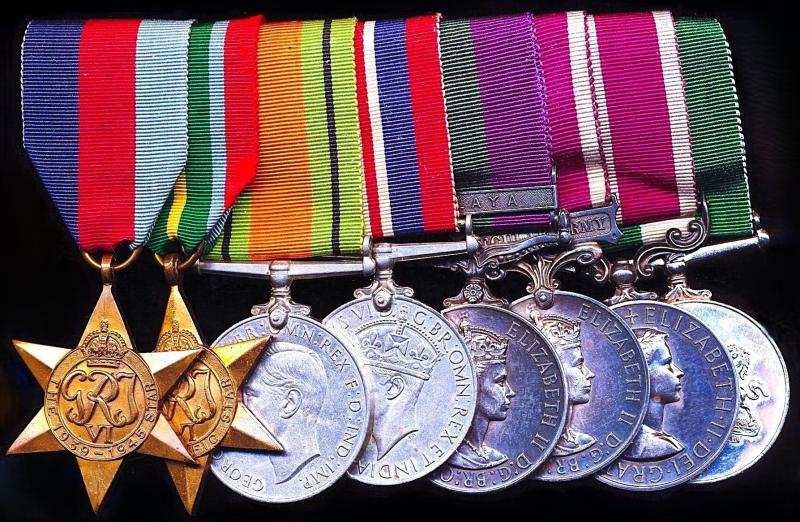
A rare Malaya Command 'Treasury Chest' Odyssey 'Singapore to Java to Freemantle' & later Nigeria Independence campaign & long service group of 9: Staff Quartermaster Sergeant Joseph William Charlie Symons Royal Army Pay Corps late Royal Engineers
- 1939-45 Star
- Pacific Star
- Defence Medal
- War Medal
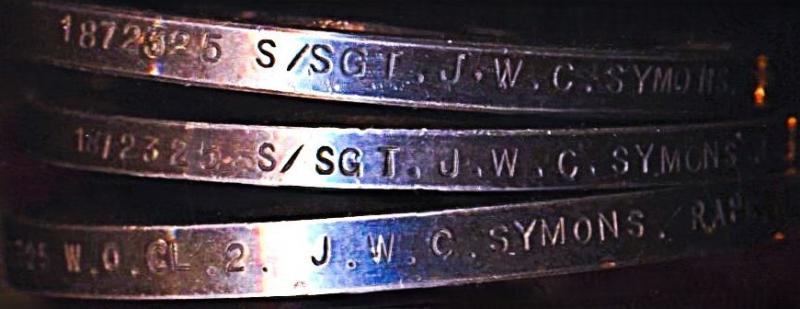
- General Service 1918-62, 1 clasp, Malaya, E.II.R. (1872325 S/Sgt. J .W. C. Symons. R.A.P.C.)
- Military LS&GC. EIIR 1st issue, Regular Army (1872325 S/Sgt. J. W. C. Symons. R.A.P.C.)
- Military Meritorious Service Medal. EIIR 2nd issue (1872325 W.O. Cl. 2. J. W. C. Symons. RAPC.)
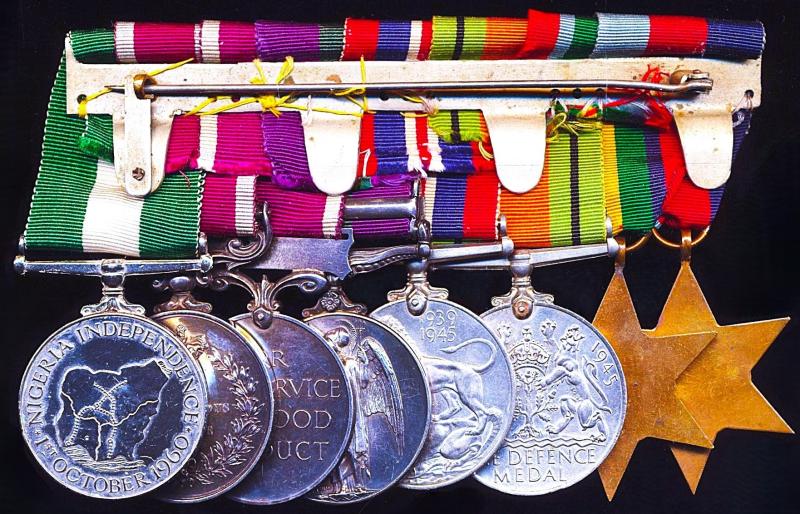
- Nigeria Independence Medal 1960. 1st type
Medals Verification: None of the medal rolls for any of the recipients medals are accessible in the public domain, and WW2 British Army medal index cards are not extant for the Army Pay Corps. We can however confirm entitlement to the below following medals from other sources:
- 1939-45 Star. No clasp: 1 day service in theatre. Confirmed 'Missing' following fall of Singapore
- Pacific Star: 1 day service in theatre. Recipient confirmed 'Missing' following fall of Singapore
- Defence Medal: RE Trace Card shows in Malaya 1940-41. For 12 months service prior to 08/12/1942
- War Medal: An automatic award for 28 days aggregated uniformed service 1939-1945
- General Service 1918-62, 1 clasp, Malaya. EIIR issue: Service 1 day or more on strength of a unit
- Military LS&GC. EIIR, 1st issue 'Regular Army': For 18 years unblemished service. Entitled October 1953
- Military Meritorious Service Medal. EIIR 2nd issue:
- Nigeria Independence Medal 1960: For 01/10/60 Per Army Council Instruction 69 of 1964
The recipients unique Army Number was from the block 1842001-2303000 awarded to the Royal Engineers in 1920, and issued sequentially thereafter to new enlistees to the Corps between 1920-1941.
By any manner of informed assessment, Joseph Symons, can be considered to have had a 'Lucky - very Lucky - War'. Present in Singapore Colony at the start of the Pacific War, 8 December 1941, he was aboard the last major liner the S.S. 'Empire Star' (he had embarked on evening 11/02/42) to safely evacuate from Singapore on 12 February 1942 - the island already invaded on 8 February 1942, by advancing Imperial Japanese Army forces - and just 3 days before the surrender of 'Fortress Singapore'. What then followed was an epic journey under constant attack to Java (Netherlands East Indies, now Indonesia) and an onward evacuation by the skin of his teeth to Freemantle, Australia. The absence of any other campaign stars in his medal group would may indicate a subsequent posting to Ceylon, or even return to the United Kingdom
Joseph's evacuation from Singapore was as a participant in the epic saga of 'Saving the Treasury Chest' of Malaya Command from falling into enemy hands!
The website of the 'Royal Army Pay Corps Association' provides the below summary about the epic flight from Singapore, by the men of the Royal Army Pay Corps:
Quote,
In early February 1942, the Island of Singapore was enshrouded in smoke which drifted over from the burning oil tanks at the Naval Base in the Johor Strait. During the time the Japanese had been moving down the Malay Peninsula it had been possible to send the accounts of soldiers by air to the United Kingdom, but the Royal Army Pay Corps Detachment (No 75) remained. By 10th February, with enemy action on all sides, it was decided to attempt the evacuation of personnel and the Treasury Chest, leaving a small band of volunteers behind
The next day, while the harbour was under continuous air attack and artillery bombardment, 46 members of the Detachment embarked on the Empire Star. They had left behind 13 volunteers. All the latter were taken by the Japanese and, it is believed, perished on the fearful Siam railway. The Empire Star was part of the last convoy to leave Singapore escorted by HMS Durban. She sailed at last light on the 11th.
Next morning there was a sustained attack by Japanese aircraft. By the time the attack ceased there had been no fewer than 131 sorties against the ship. It had been hit three times, with a near miss from a bomb of major calibre. Miraculously only 23 of the 2,000 soldiers aboard were killed. Corps personnel had helped to serve the three inch guns and had joined in ineffectual rifle fire against enemy aircraft. Despite blundering into a minefield, the Empire Star docked in Djakarta. The Treasury Chest was transferred to another vessel along with four members of the Corps. It eventually found its way back to England.
Except for two officers and six soldiers who remained in Bandoeng, the rest of the party took part in an exercise to persuade the mutinous crew of SS Wu Sang to man their deserted ship. The strangest voyage in the history of the trooping of the Royal Army Pay Corps began. In addition to the soldiers there were 10 war correspondents, a white Russian lady and two dancing girls. Storms swept the vessel as she moved into the Indian Ocean. Twice the coal shifted, with dangerous listing as a result. Despite all, battered and begrimed, they disembarked in Fremantle, Australia.
Unquote.
Treasury Chest Stations: In 1939 the British Army had 7 x Treasury Chest Stations spread across the British Empire, they were located at: Hong Kong, Singapore, Bermuda, Ceylon, Gibraltar, Malta and Jamaica. Post. The Treasury Chest' of the China Command, was lost in December 1941, and that at Singapore Colony was successfully - and miraculously - safely evacuated, the day before the fall of Singapore in February 1942. The Chests were operated by the Treasury Chest Officers, who are normally the. Army Command Paymasters. The Treasury Chest is a capital fund of £700,000 (fixed by Statute) placed at the disposal of the Treasury for the purpose of supplying funds for the public service at certain places abroad in order that the provision of funds for the Fighting Services at those places may be in the hands of one man (the Treasury Chest Officer) under the direction of the Treasury instead of being dealt with separately by each of the Services. Currency is raised locally by the Treasury Chest Officer by telegraphic transfer or by bill of exchange on London or, e.g., by taking over, against adjustment in London, available funds of the local Government, which may be seeking remittance. But as no expenditure may be charged finally to the Fund all payments to or advances from the Treasury Chest stations abroad are subsequently adjusted in London between the Treasury and other Departments concerned. Any profits on exchange made by the Treasury Chest Fund are surrendered to the Exchequer, and any losses are covered by Vote of Parliament
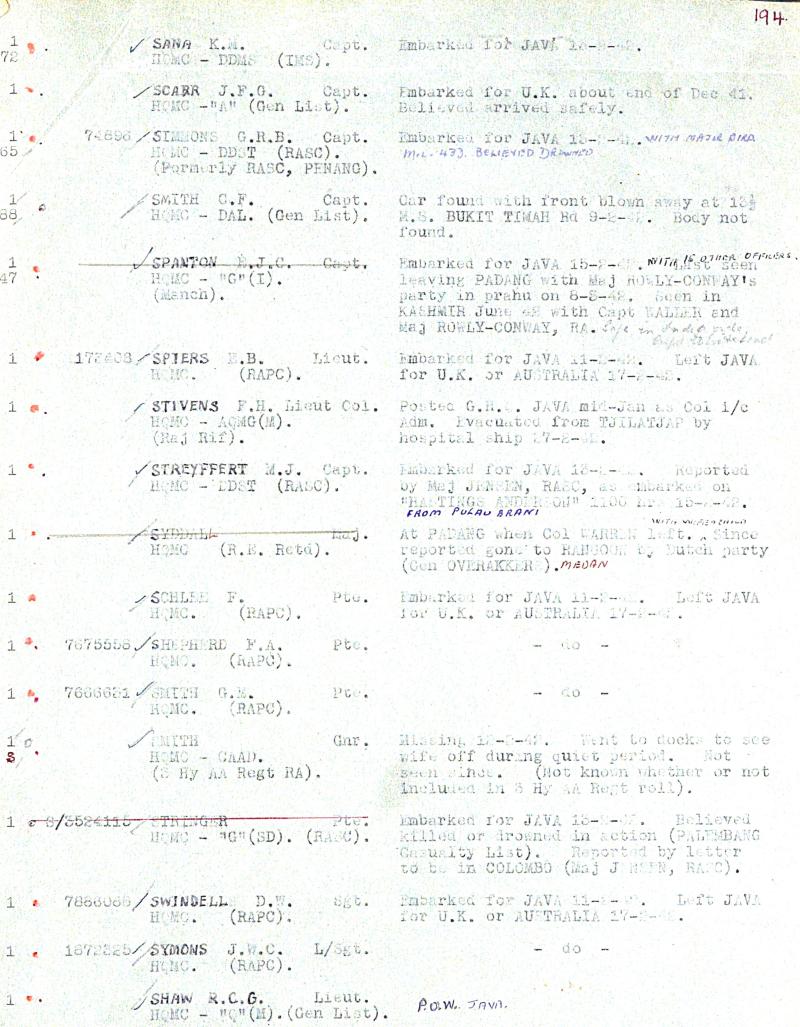
Joseph William Charlie Symons, son of Albert George Symons (a Wheelright, & former L/Cpl Royal Engineers, employed at Woolwich Arsenal) and Emily Jane Symons (nee Coppen) was a native of West Plumstead, Woolwich, London, where he was born, 1 February 1918. At the time of his birth his family resided at 160 Robert Street, Plumstead. By trade a 'Carpenter' (his marriage certificate refers), Joseph is recorded as enlisting in the British Army on, 1 October 1935, at which time he was posted to his father's old corps the Royal Engineers. From 4 December 1937 he was serving with the 34th Fortress Company R.E.. Next he was posted to 30th Field Company R.E. and sub unit 14/30 (F) Coy R.E. / 2nd Echelon, Malaya Command from 15 June 1941. he held the rank of 'Sapper' in the R.E. and is recorded to have transferred from the corps, to the Royal Army Pay Corp in Malaya on, 10 September 1941.Joseph was evacuated form Singapore on 12 February 1942, part of the 'R.A.P. C. Treasury Chest' detail (see above aforementioned). British Army casualty lists conform him holding the rank of Lance-Sergeant and serving with R.A.P.C. under higher formation Headquarters Mala Command, showing him as having embarked Singapore 11/02/1942 for Java,Netherlands East Indies, with vague remark left Java for Australia or the United Kingdom, 17/02/1942. In the event, it has been confirmed that Lance-Sergeant Symons actually reached the Port of Freemantle, Western Australia on, 2 March 1942, having arrived on the British-Singapore vessel S.S. Klang, that had left the Javanese port of Tandjong Priok, as part of Convoy 'SJ.6' (Australian Archives records of passenger manifest for incomimng refugees / arrivals refer. Joseph was serving in the United Kingdom at least from January 1945 - as by then a Sergeant he married No. W/115673 Private Dorris May Taylor of the Army Territorial Service in Hackney, London on, 20 January 1945. After retiring from his many years service in the British Army Joseph accepted an appointment as a Civil Servant. He is recorded to have died at the Royal Sussex County Hospital, Brighton, England on, 17 September 2013, at the time of his death his usual address was recorded as having been, 12 Castle Road, Worthing, West Sussex
The medals mounted in the swing style, and as worn by the recipient. The medals suspended from a white metal mounting bar that retains its long hinged pin & clasp fittings
An extremely scarce and desirable medal group to the British Army, to a soldier who was fortunate to have avoided death and or capture during the ill-fated Malaya Campaign
Condition: The silver medals dark toned. The group GVF
Code: 25862