


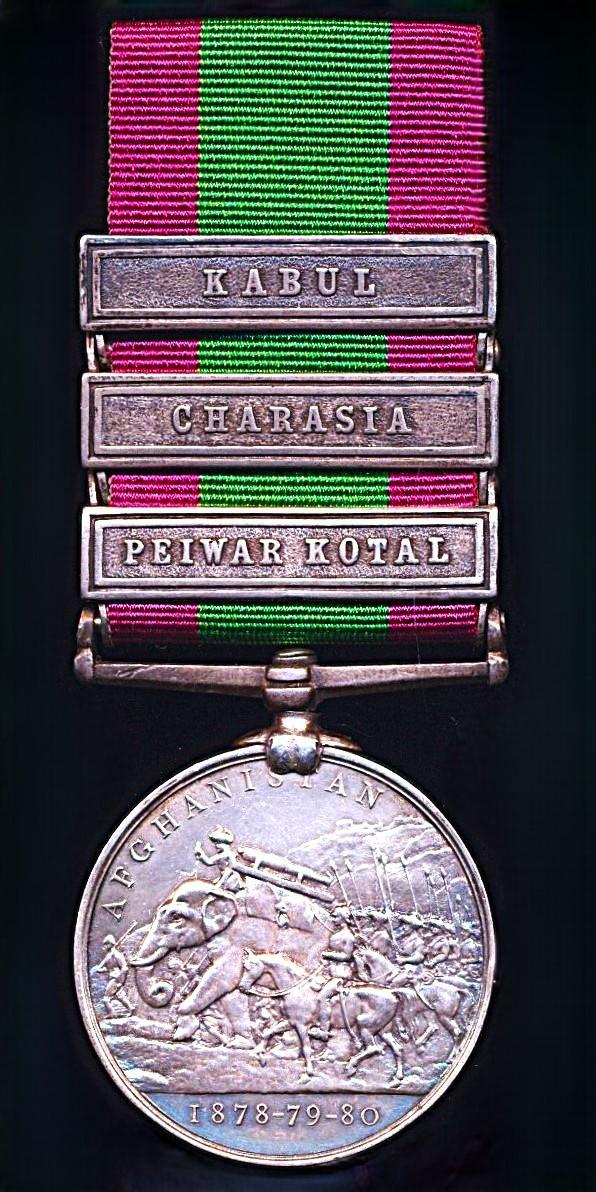
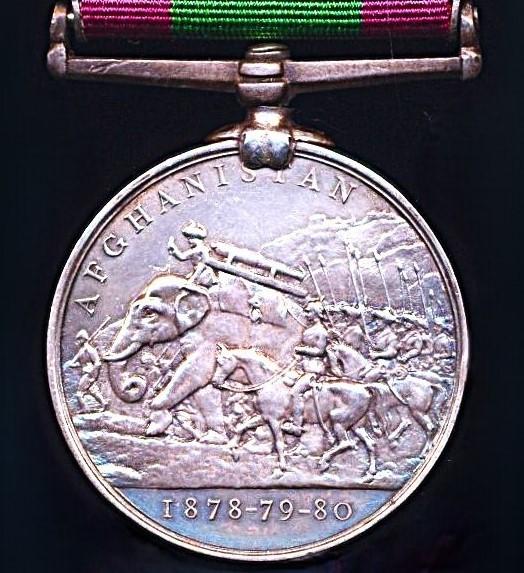
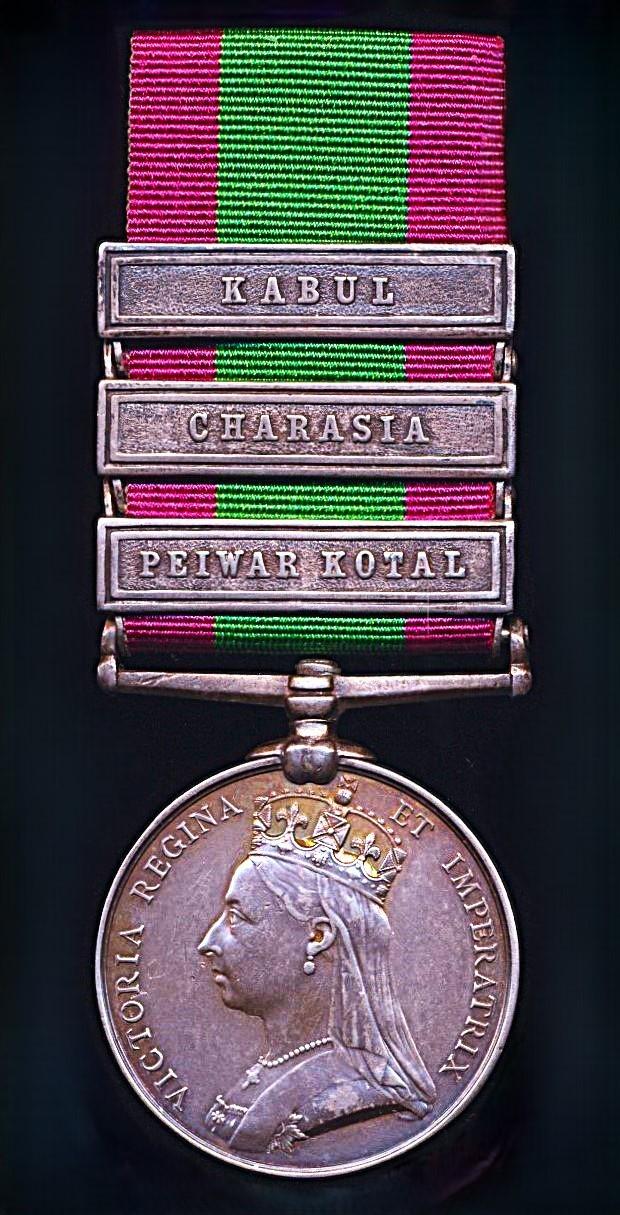
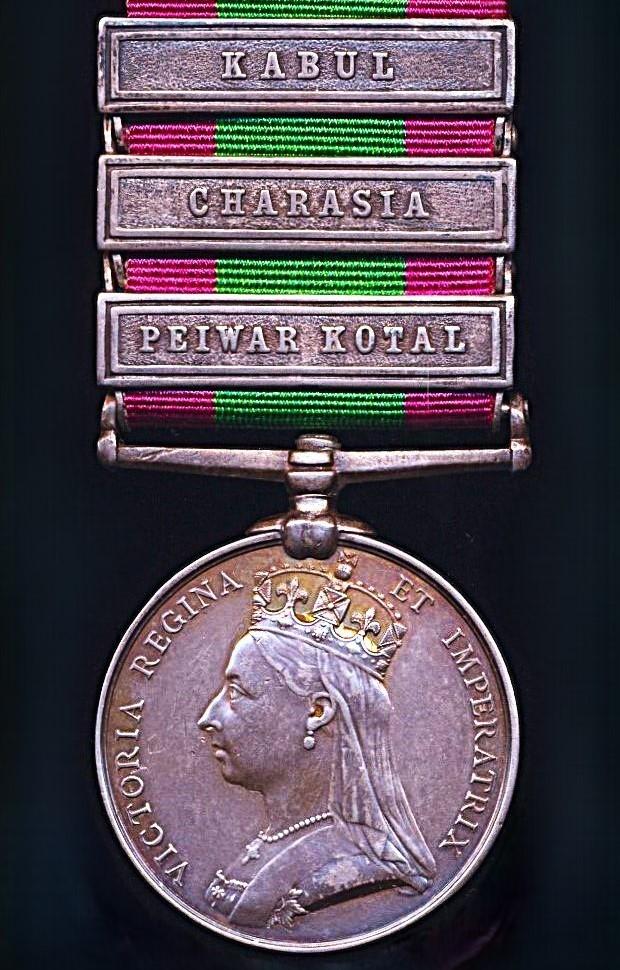

Afghanistan War Medal 1878-80. With 3 x clasps 'Cabul', 'Peiwar Kotal' & ' Charasia' (No 906 Gr. J.W. Wilson. F/A Bde R.H.A.)
The naming on this medal is contemporary officially re-named. The medal clasp rivets are all 'as issued', and presumably issued as an un-marked replacement medal at sometime during the Victorian era
The recipient was No. 906 Gunner Joseph Walter Wilson who served with 'F' Battery 'A' Brigade Royal Horse Artillery
Medal & Clasps Verification: The recipient's entitlement to the medal with below 2 x clasps is confirmed per the respective campaign medal roll of the Royal Horse Artillery referenced below:
- Afghan Medal 1878-80 & clasps 'Peiwar Kotal' & 'Charasia': WO 100/54
The extant medal roll shows no indication that the recipient was entitled or issued to a 'Kabul' clasp, or that any replacement or duplicate medal was ever issued with 3 x clasps
The medal roll with remarks entered that the recipient had taken his discharge by purchase from the British Army on 13 November 1880, and that his original medal with 2 x clasps when issued was sent to the Adjutant General's Office on 31 December 1881. Extant pension records (ref WO 121/237 held at The National Archives ) show that at the time of his discharge by purchase from the British Army, Gunner Joseph Walter Wilson was holding the regimental number 3403 and was serving with C Brigade Royal Regiment of Artillery. At discharge he had accumulated 12 years service towards pension
While the medal roll makes no reference to any entitlement of the recipient to a clasp for 'Kabul' - there is ample evidence that the guns of the battery were present at Kabul, as the clasp was the most prolific awarded to the battery
Reference 'British Battles and Medals' (Spink, 7th Edition 2006), the below following numbers of clasps are recorded being awarded to F Battery A Brigade Royal Horse Artillery for the Second Afghan War:
- Peiwar Kotal: x 26
- Charasia: x 58
- Kabul: x 135
No men of F Battery A Brigade Royal Horse artillery were either present or entitled to any other clasps for the Second Afghan War, or the Kabul to Kandahar Star
The below following regimental abstract of service in the Afgahn War 1878-80 is taken from the stanrd reference for that war, viz 'The Afghan Campaigns of 1878-1880 (S. H. Shadbolt, 1882)':
Quote,
F BATTERY, A BRIGADE, R.H.A.
On the massing of the troops on the frontier in the autumn of 1878, Battery F/A, R.H.A., under the command of Major W. Seviling, was ordered up from Campbellpur, where it was at the time stationed, to Kohat, and from thence to Thai, to form part of the force under the command of General Roberts.
Taking part in the advance of the Division into Afghanistan, the battery was engaged, on the 28th Nov., 1878, in the skirmish of that date with the enemy. In the assault and capture of the Peiwar Kotal on the 2nd Dec., four guns were told off to support the turning movement commanded by the General in person, two guns remaining temporarily in camp, and subsequently being prominently engaged in the direct attack on the enemy’s position conducted by Brigadier-General Cobbe. For the next few months the battery, broken up into divisions, did duty at Fort Kuram, Hazar Pir, and Thai, eventually reuniting and proceeding to Ali Khel, where it remained with the advanced troops on the Kuram line till the succeeding autumn.
On the renewal of hostilities in September, 1879, F/A, R.H.A., now under the command of Major J. C. Smyth-Wyndham, made its way over the difficult Shutargardan Pass without casualty or mishap, and took part with the newly-organized Kuram Division, Kabul Field Force, in the advance on and occupation of Kabul. During the action of Charasiab, on the 6th Oct., the battery was in reserve.
On the 1st Nov. two guns of the battery left Kabul with the force under Brigadier-General Macpherson, which proceeded to Kata Sang to meet the advanced portion of General Bright’s Division from the Khyber.
On the 1st Dec. two guns of the battery left Kabul for India, forming part of the escort of the ex Amir, who, since the 27th September, had been a prisoner in the British camp. Four guns of the battery accompanied the column under Brigadier-General Macpherson, which was despatched from Kabul on the 8th Dec., 1879, to force a gathering of the enemy towards Maidan, and were left on that day with the Cavalry of the force, at Killa Affshar. On the 10th they were engaged in an attempt to cut off the enemy’s retreat, but were precluded by the physical difficulties of the country from getting into action. The following day the Cavalry and Artillery, now under the command of Brigadier General Massey, made their way across country to await the arrival of Brigadier-General Macpherson’s force on the Ghazni road, and in doing so, came into disastrous conflict with overwhelming numbers of the enemy at Killa Kazi. The battery, after getting three times into action, was at length ordered by Sir F. Roberts, who had arrived on the scene and assumed command, to retire before the oncoming hordes, whose advance the charges of the Cavalry failed to check. After they had moved back a short distance, the guns were completely stopped in their further retirement by a deep watercourse, and it became necessary to spike and abandon them. In this engagement, a gallant young officer of the Battery, Lieut. E. Hardy, and one man, were killed; seven horses were also killed, and two wounded. Later in the day, after the defeat of the enemy by Brigadier-General Macpherson’s force, the guns were recovered by a party of men under Col. MacGregor, R.A., Deputy Quartermaster-General.
On the 14th Dec., four guns of the battery, under Captain Pipon, were brought into action near the south-west corner of the Sherpur cantonments in covering the advance of Brigadier-General Baker’s force in support of a detachment holding the conical hill after the assault of the Asmai Heights, and contributed to rendering the enemy’s position untenable. While this event was in progress, the two other guns were despatched with a small force of Cavalry under Brigadier-General Gough to disperse a body of the enemy who were reassembled on the Siah Sang.
After-the withdrawal of the troops within the lines of Sherpur, the battery took part during the siege in the defence of the cantonment, and was engaged in the repulse of the enemy’s attack on the 23rd Dec.
On the 20th April, 1880, two guns of the battery accompanied the force under Brigadier-General Jenkins, which marched on that day towards Charasiab, and on the 25 th idem performed excellent service in the defeat of the enemy near Childukhtean.
Quitting Kabul on the 11th May, 1880, the battery commenced its laborious return-march to India. After recrossing the frontier, it made its way back to its old station, Campbellpur
Unquote
Condition: VF
Code: 25698
240.00 GBP