


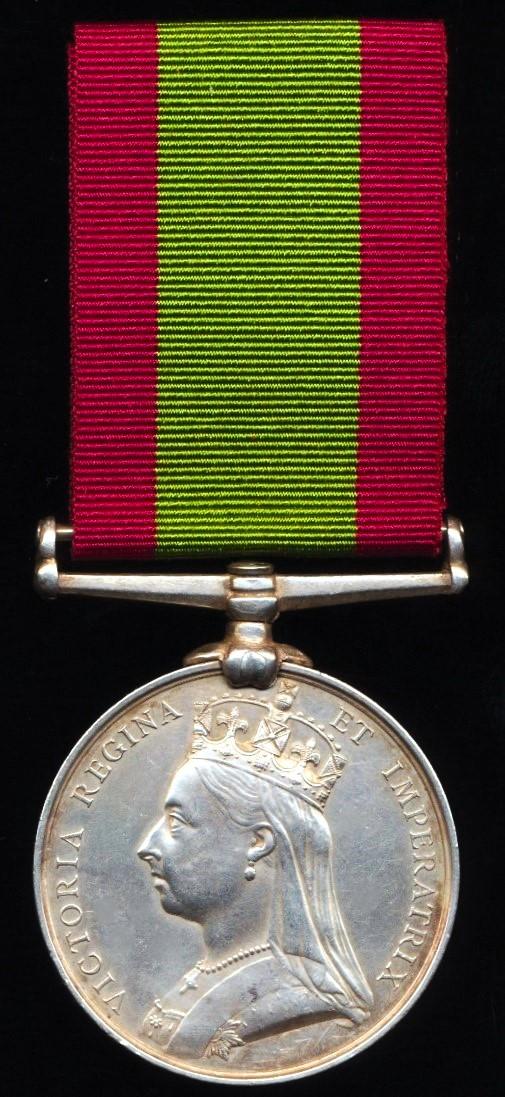
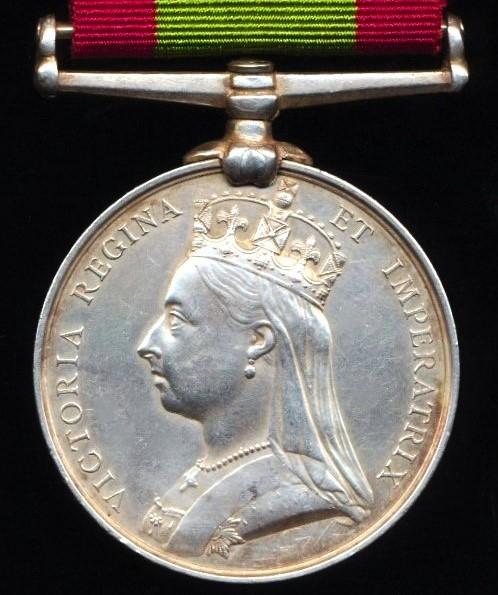
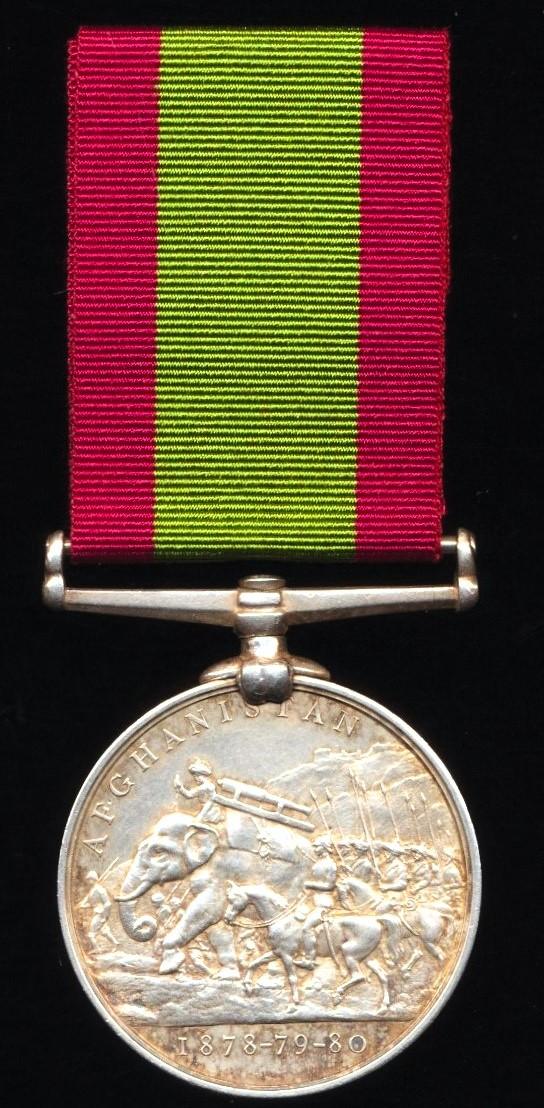
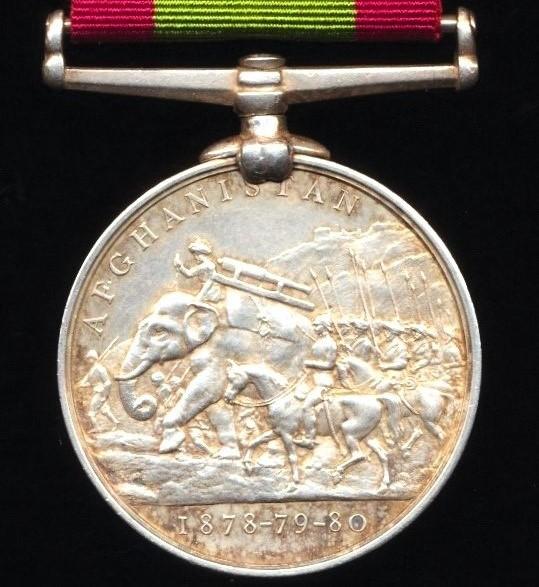

Afghanistan Medal 1878-80. No clasp (1382, Pte. G. Thompson. 78th Foot)
Died of Disease: Private George Thompson, 2nd Battalion Seaforth Highlanders (Ross-shire Buffs. The Duke of Albany's), late 78th (Highlanders) Regiment of Foot (The Ross-Shire Buffs), is confirmed to have died of 'Cholera', at, Chunar. North West Frontier Province of, British India, on, 1 November 1881
At the time of his recorded death, Private George Thompson (b. 1860) was 28 years of age. His body was buried at the Trinity Church, Cemetery, Chunar (N.W.F.P.), British India (now located in Pakistan), on, 2 November 1881
Medal Verification: No. 1382 Private George Thompson, 78th Foot, is confirmed entitled to the Afghan War Medal 1878-80 without clasp, per the below referenced medal roll of the 78th Foot
- Afghanistan War Medal 1878-80. No clasp: WO 100/53. With remark 'Deceased 1.1.1881'
The below following regimental abstract of service in the Afghan War 1878-80 is taken from the standard reference for that war, viz 'The Afghan Campaigns of 1878-1880 (S. H. Shadbolt, 1882)':
Quote,
78th HIGHLANDERS (ROSS-SHIRE BUFFS). NOW 2nd BATTN. SEAFORTH HIGHLANDERS (ROSS-SHIRE BUFFS).
The 78th Highlanders, under the command of Lt.-Colonel A. E. Warren, left Poona on the 9th August, 1880, as part of the reinforcement furnished to the Army in Afghanistan by the Bombay Presidency, on the news of the battle of Maiwand reaching India.
The regiment was sent by sea to Karachi, where it was detained for ten days, till Major-General Phayre, C.B., telegraphed orders for it to move on Quetta.
Starting on the 24th August, the regiment was sent on to Sibi in four detachments, the Head¬ quarters and two companies leaving on the 24th, two companies on the 25th, two on the 26th idem, and two on the 1st of September. These two last had been detained as a garrison for Karachi and Haidarabad (Sind), on the occasion of the anticipated outbreak of Pathans in Sind at that time.
From Sibi the various detachments of the regiment proceeded via the Bolan Pass to Quetta by forced marches. At Sibi four companies had been ordered to march to Kalat to the assistance of the Khan, who expected a rising of the Kakar Pathans ; but this order was cancelled by telegraph four or five days later, before the leading detachment had turned off the Quetta road in the direction of Kalat.
The seven days’ march to Quetta, owing to the great heat of the weather and want of transport, was of a very arduous description. At Quetta the regiment was halted, the news of General Sir Frederick Roberts’ victory on the 1st September being received the evening that the Head-quarters of the regiment marched in.
During the stay of the 78th in Quetta, considerable sickness prevailed amongst the troops in garrison, and 104 men of the 752 that had been in Karachi were invalided.
On the 3rd November the Head-quarters and four companies, under command of Lt.-Colonel Warren, marched for Kandahar, the other four companies remaining in Quetta till the 23rd November, when, being relieved by the 61st Regiment, they also moved forward and eventually rejoined the first half-battalion. The Head-quarters reached their destination on the 15th Nov., 1880, and were posted to the 2nd Infantry Brigade, being quartered in the old cantonments till the evacuation took place.
The Brigade of which the 78th Highlanders formed part quitted Kandahar on the 20th April, 1881. The regiment arrived at Sibi on the 13th May, whence it proceeded by rail to Bengal.
78th (Highlanders) Regiment of Foot (The Ross-Shire Buffs): The regiment had a long history of overseas campaign service 'East of Suez' principally in Persia, India and South East Asia, for which the 78th were awarded the distinction of an 'Elephant' with title 'Assaye' and had earned the below following battle honours:
- Assaye
- Java
- Koosh-Ab
- Persia
- Lucknow
- Afghanistan 1879–80
In 1881, 78th (Highlanders) Regiment of Foot (The Ross-Shire Buffs), were amalgamated with the 72nd (Duke of Albany's Own Highlanders) Regiment of Foot, to form the Seaforth Highlanders (Ross-shire Buffs, The Duke of Albany's) Seaforth Highlander, at which time the former 78th became the 2nd Battalion of the Seaforth Highlanders. The Seaforth Highlanders, had the unique distinction of being the only infantry regiment of the British Army (post 1881 Cardwell Army Reforms), that was comprised of two battalions that had both served in Afghanistan during the Second Afghan War 1878-80
Condition: GVF
Code: 23427
185.00 GBP