


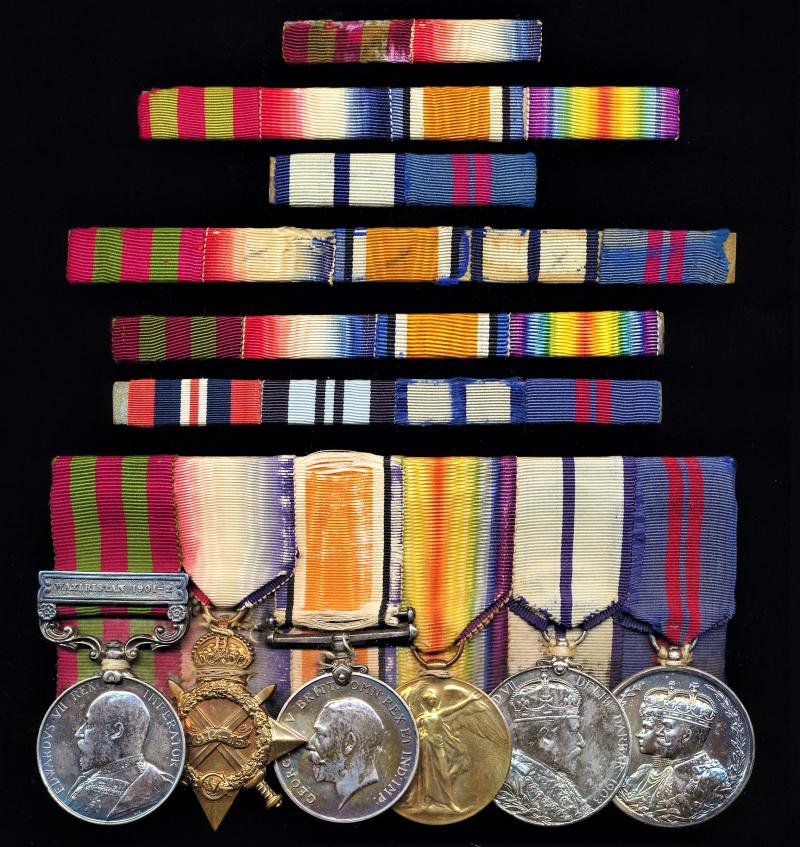
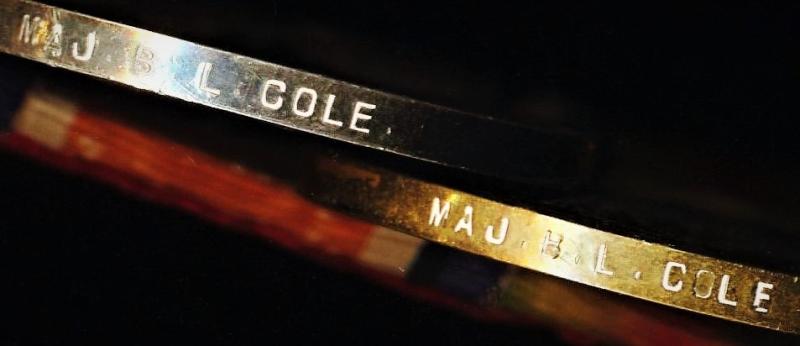
A superb Indian Army Officer's 'Battle of Tanga Casualty' campaign & scarce brace of 'Durbar' medals group of 6: Colonel Brian Lytton Cole, late Commanding Officer 1st (Wellesley's) Battalion 6th Rajputana Rifles & 13th Rajputs, Indian Army
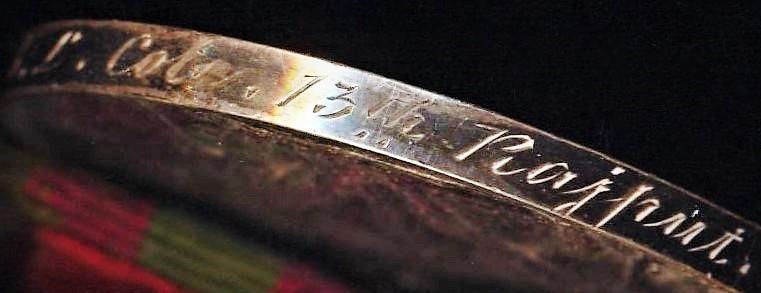
- IGS 1895-1902. EDVII Silver (Lt B. L. Cole, 13th Rajputs.)
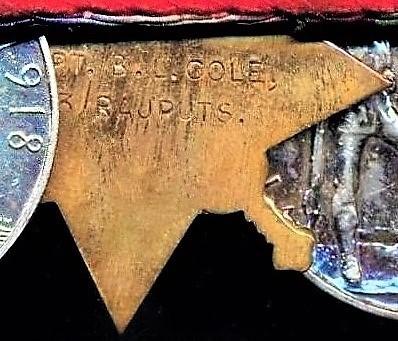
- 1914-15 Star (Capt. B. L. Cole. 13/Rajputs.)
- British War Medal. Silver issue (Maj. B. L. Cole.)
- Interallied Victory Medal (Maj. B. L. Cole.)
- Durbar Medal 1903. Silver issue)
- Durbar Medal 1911. Silver issue
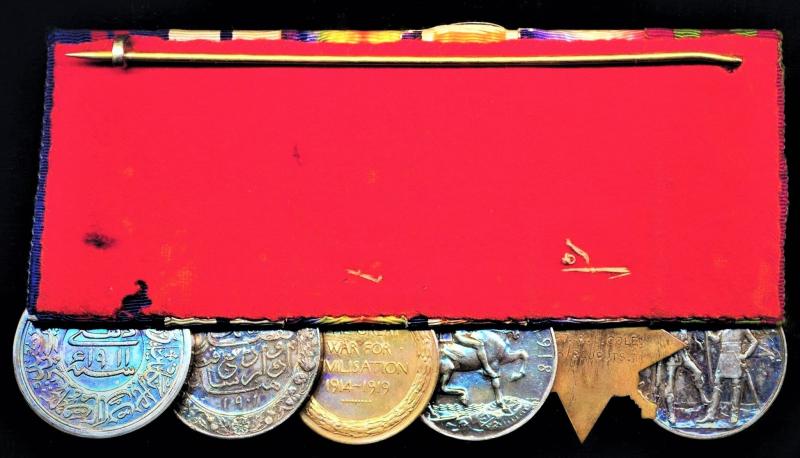
Sold together with a quantity of original riband bars as variously worn by Colonel Cole, between 1911-1946, and all of which retain their long-hinged pins and clasp fittings on the reverse.
Medals verification: All campaign medals & clasp confirmed as entitled per the Indian Army List and or respective medal rolls cited below:
- IGS 1895-1902. EDVII & clasp: WO 100/75 (only 11 x EDVII medals to BO's of 13th Rajputs)
- 1914-15 Star: Indian Army List, Jan 1924 Supplement 'Operations in E. Africa 2nd Nov. to 5th Nov. 1914
- British War Medal. Silver issue: Ref WO 329/2389
- Interallied Victory Medal: Ref WO 329/2389
- Durbar Medal 1903. Silver issue: Ref WO 100/111 (Only 8 x medals to 13th Rajputs)
- Durbar Medal 1911. Silver issue: Ref WO 100/400 (Only 10 x medals to 13th Rajputs)
In addition to above, Colonel Cole was also entitled to the War Medal & India Service Medals for service in India during the Second World War, and as evinced by his extant tunic medal riband bar he wore the ribands while in service
Note: Only 2 x British Officers of 13th Rajputs were awarded Durbar Medals in 1903 & 1911 respectively, but Lieutenant / Captain B. L. Cole was the only British Officer to receive a 'Brace' of Durbar Medals. The only Indian member of the 13th Rajputs , to earn a 'Brace' of Durbar Medals was Viceroy's Commissioned Officer, Subadar-Major 'Bahadur' Harnam Singh, O.B.I
Important: Colonel Cole, was one of the foremost, sources of knowledge and expertse on the martial classes of Rajputana. He served and lived lived in Rajputana, for about forty years of his career. A truly remarkable achievement. Such was his extensive services in India, that there is just too much to write in detail here. We would however urge clients to consult the extensive on-line resources in both the United Kingdom, especially the extremely detailed 13th Rajputs Battalion War Diary held at The National Archives, and the former India Office Collections held at The British Library, while in India, the National Archives in Delhi have numerous files in their archives pertaining to various appointments and reports made by Colonel Cole during his long years of service. Colonel Cole's milestones include:
- 1921: Author of 'The Recruiting Handbook for Rajputana Classes
- 1922-1926: Commandant (Commanding Officer) 1st (Wellesley's) Battalion 6th Rajputana Rifles
- 1926: Appointed 'Recruiting Officer', Ajmer, Rajputana
- 1929: Appointment as Officiating Guardian to His Highness the Maharaja of Jaipur
- 1932: Retires from Indian Army
- 1934: Marriage to Scottish Missionary Doctor, Dr. Margaret Winifred Hume (31), described as 'Doctor M.B., Ch.B', at, St. Andrews (Scottish Mission) Chandpole Church, Jaipur, on 9 January 1934
- 1939-1946: Appointment as Colonel & 'Chief Civil Liaison Officer, Rajputana & Central India'
- 1946: Colonel Brian Lytoon Cole dies at Ajmer, Rajputana
Brian Lytton Cole, son of Henry Hardy Cole (Captain, Royal Engineers, Indian Service) & Catherine Jane Cole (nee Cooper, an Irish woman from Co. Sligo) was a 'Son of the British Empire' born in, Simla, British India on, 26 May 1880. Like his father before him, Brian chose a military career, and on, 25 June 1899, having prior been a Gentleman Cadet at the Royal Military Academy, was commissioned as a Second Lieutenant in the Royal Regiment of Artillery, of the British Army. Promoted Lieutenant in 1901, in same year he trnsferred to the British Indian Army, and was posted to the 13th (Shekhawati) Rajput Infantry - and the start of his more then 40 years association and service with Rajputs and Rajputana. During the Great War, Brian served with the 13th Rajputs as a Double Company Commander, at the Battle of Tanga, German East Africa, where on 4th November 1914, he was severely wounded-in-action, and captured by the German Colonial Force - the hard fighting Askaris of the 'Schutztruppe ' - commanded by the legendary Paul Emil von Lettow-Vorbeck, also called the Lion of Africa (Löwe von Afrika). Granted release on 'Parole', Brian was repatriated to British India, where he remained for the duration of the war. Post war, he held the prestigious regimental appointment as Commandant (Commanding Officer) of 1st (Wellesley's) Battalion 6th Rajputana Rifles. Brian Lytton Cole (53) described as 'Lt-Colonel (Retd)' married Margaret Winifred Hume (31), described as 'Doctor M.B., Ch.B', at, St. Andrews (Scottish Mission) Chandpole Church, Jaipur, on 9 January 1934. Brian Cole remained resident in Rajputana the rest of his life, and during the Second World War, was back in iniform holding the rank of Colonel & the appointment of 'Chief Civil Liaison Officer, Rajputana & Central India' - the National Archives in New Delhi having numerous files pertaining to his service in Rajputana during the War Years. He was released from his appointment on, 10 June 1946, and died at his home at Ajmer, Rajputana on 30 December 1946
Great War Service: Below is just a brief summary, but clients are strongly recommended to access and read the extremely detailed battalion war diary of the 13th Rajputs, which contains exhaustive detail on the Battle of Tanga, including pages of accounts, including personal submitted narratives, from and about Captain Cole.....
At the Battle of Tanga, 3-4 November 1914, Captain Cole was severely wounded-in-action, being hit by gunshot and shrapnel wounds on two separate occasions. The wounds totally incapacitated Captain Cole, es evinced by the recommendations submitted by Lieutenant Hammrick:
Quote,
Sub. Parbhudan Singh, both in the advance up the main street of Tanga & in bringing Captain Cole back showed the greatest coolness & bravery. He took Captain Cole on his back and carried him up the steps of the railway cutting and had Captain Cole actually on his back when he received his second wound. The Subadar then pulled Captain Cole back into the cutting & remained with him until he was brought out, by our right flank
Unquote.
Quote,
Captain Cole told the men with him to go, several times, but they would not. Two of the three wounded could not walk.
Unquote
The 13th Rajputs War Diary, includes detailed appendices with two lists of 'Recommendations' for Honours & Awards. The preamble of the listing of five British Officers recommended by the Commanding Officer states:
Quote,
I would bring to special notice the exception gallantry and coolness on various occasions of:
Captain B. L. Cole
3rd & 4th November - especially afternoon of 4th
Captains Seymour and Cole and Lt. Ferguson did useful reconnaisance on the night of 2/3rd Nov.
Unquote.
The final regimental list of Indian Officers recommended for Honours & Awards was submitted by the Commanding Officer 13th Rajputs, and included in the detailed Battalion War Diary of the unit, is headed by:
Quote,
Subadar Parbhudan Singh ('C' Co)
Specially recommended for great gallantry in Tanga town on the 4th Nov 1914 - He and a few others (elsewhere recommended) brought back Captain Cole and other wounded men. The party was at one time, isolated in the cutting - but eventually brought the wounded back to safety.
Subadar Parbhudan, was and had been been for some days, sikc, though not on the sick list.
Unquote.
In the event Subadar Parbhudan Singh was rewarded with admission to the prestigious and highly coveted Order of British India, not for long and meritorious service, but as an 'Immediate Award' for gallantry at the Battle of Tanga. The other two Indian 'Other Ranks' who were recommended for their gallantry and devotion to Captain Cole, were 2526 Sepoy Rampertab Singh & 2430 Sepoy Ramratan Singh, both of 'C' Company, 13th Rajputs. Their joint recommendation stating:
Quote,
Brought out Captain Cole severely wounded under heavy fire, remaining isolated with him, and two other wounded men, eventually reaching safety. Gallantry - in Tanga - 4 Nov. 14.
Unquote.
Unlike, Subadar 'Bahadur' Parbhudan Singh, O.B.I., Sepoy's Rampertab Singh & 2430 Sepoy Ramratan Singh, were not subsequently decorated. Indeed very few gallantry awards were ever awarded for the Battle of Tanga - a battle that the Official War History later described as 'one of the most notable failures in British military history '. No gallantry awards were awarded to British Officers, and the only gallantry awards subsequently bestowed on the Indian 'All Ranks' of the 13th Rajputs were:
1 x Order of British India (Second Class with title 'Bahadur', 2 June 1916)
1 x Indian Order of Merit
2 x Indian Distinguished Service Medals
Prisoner-of-War. Severely wounded in two places, Captain Cole was captured at Tanga, by the victorious German colonial forces, or, 'Schutztruppe', under the leadership of the legendary Lettow-Vorbeck. With no capacity to retain their prisoners, the German's negotiated a 'Parole' with the British, whereby they would return captured British Officers, including Captain Cole, on the strict undertaking that the British Officer POW's, would only be released on parole, providing they undertook never again to bear arms against the Germans for the duration of the war. For Captain Cole, his parole terms, required that he continue to serve in British India, for the remainder of the Great War
The Battle of Tanga, sometimes also known as the Battle of the Bees, was the unsuccessful attack by the British Indian Expeditionary Force "B" under Major General A. E. Aitken to capture German East Africa (the mainland portion of present-day Tanzania) during the First World War in concert with the invasion Force "C" near Longido on the slopes of Mount Kilimanjaro. It was the first major event of the war in Eastern Africa and saw the British defeated by a significantly smaller force of German Askaris and colonial volunteers under Lieutenant Colonel Paul von Lettow-Vorbeck. It was the beginning of the East African Campaign of World War I, and is considered one of greatest victories of the Schutztruppe in Africa. The British retreat enabled the Schutztruppe to salvage modern equipment, medical supplies, tents, blankets, food and a number of Maxim machine guns which allowed them to successfully resist the allies for the rest of the war.
Colonel Brian Lytton Cole, Indian Army, of, Upper Mission Bungalow, Ajmer, Rajputana, India, died there on, 30 December 1946
The recipients Officers service papers are extant and are held and accessible at The British Library (ref IOR/L/MIL/14/15675)
The medals mounted as-worn by the recipient in the court-style. The reverse of the medal mounting bar retaining the original long hinged pin & clasp fittings
A superb & unique regimental grouping to a British Officer of the 13th Rajputs, with every medal in the group awarded to the recipient for his service with the 13th Rajputs
Some fraying, commensurate with age, on the silk riband of the BWM
Condition: Silver medals toned VF
Code: 22516