


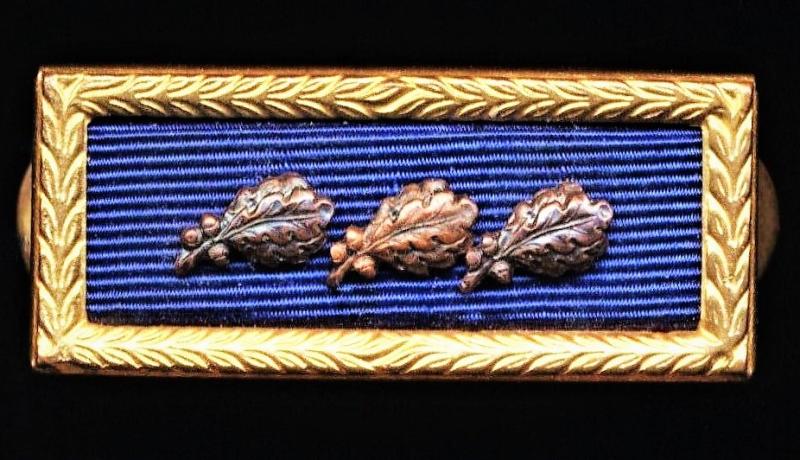
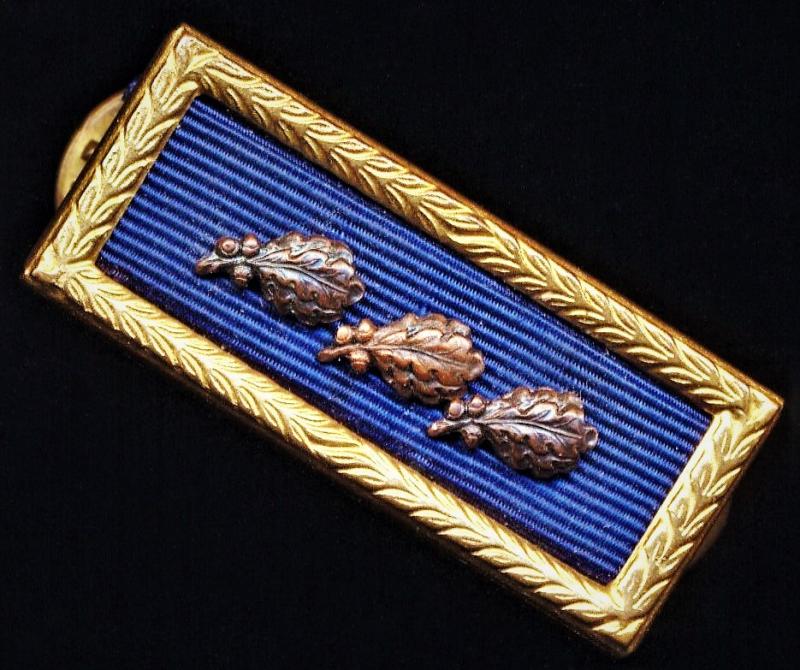
Netherlands: United States Presidential Unit Citation, with 'Oakleaf' emblem, as awarded and worn by member of the Regiment van Heutsz, Korea 1951
As awarded in Korean War era to Regiment Van Heutsz, of the Netherlands United Nations Contingent sent to Korea where they were awarded the Presidential Unit Citation twice for actions during the Korean War. The first citation was awarded after the battle near Wonju and Hoengson in February 1951. The unit was awarded a second time for its bravery during the Soyang River Battle in May–June 1951
Important: The oakleaf emblem denotes that the unit had been twice decorated with the Presidential Unit Citation
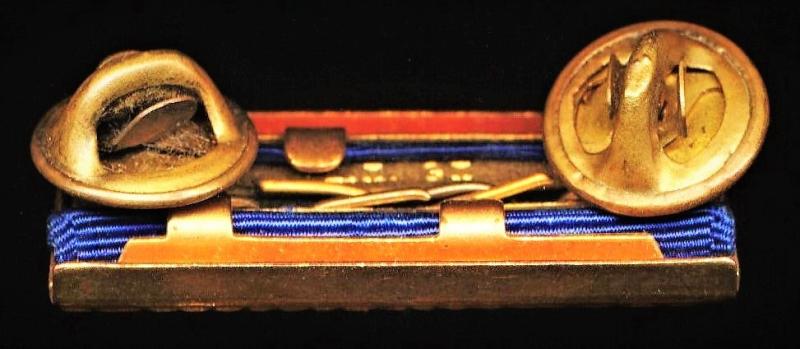
A blue silk 'moire' riband contained within gilt frame. The citation complete with gilt frame border and -as-worn
The insignia is worn on the right breast by recipients of units (United States & Allies) that were collectively decorated with the award of the Presidential Unit Commendation
The Presidential Unit Citation (PUC), originally called the Distinguished Unit Citation, is awarded to units of the uniformed services of the United States, and those of allied countries, for extraordinary heroism in action against an armed enemy on or after 7 December 1941 (the date of the Attack on Pearl Harbor and the start of American involvement in World War II). The unit must display such gallantry, determination, and esprit de corps in accomplishing its mission under extremely difficult and hazardous conditions so as to set it apart from and above other units participating in the same campaign
The collective degree of valour (combat heroism) against an armed enemy by the unit nominated for the PUC is the same as that which would warrant award of the individual award of the Distinguished Service Cross, Air Force Cross or Navy Cross. In some cases, one or more individuals within the unit may have also been awarded individual awards for their contribution to the actions for which their entire unit was awarded a Presidential Unit Citation
Regiment Van Heutz: The Regiment van Heutsz is a line infantry regiment of the Royal Netherlands Army. The regiment was named after J.B. van Heutsz, a former Governor-General of the Dutch East Indies, and was formed on July 1, 1950. It is notable for its service as part of the United Nations force sent to fight during the Korean War. It is still operational and has served tours as part of the ISAF Afghanistan Mission
From 1832 to 1950 a substantial colonial army was maintained in the Dutch East Indies under the title of the Royal Netherlands East Indies Army (KNIL). Following Indonesian independence the Dutch and indigenous personnel of this force were demobilised but with the establishment of the Regiment van Heutsz on, 1 July 1950, the traditions and distinctions of the KNIL were transferred to the new regiment. These included the inscription 'Military Operations Royal Dutch East Indies Army 1816-1950', still carried on the banner of the regiment
The van Heutsz Regiment was incorporated into the Nederlands Detachement Verenigde Naties (NDVN) (English: Netherlands Detachment United Nations), which also included the Dutch Naval component sent to Korea. While 16,225 people volunteered for service in Korea, only 3,418 men were accepted and sent. 2,980 of those participated in the actual war, as the units that arrived after the armistice (July 27, 1953) did not participate in any fighting.2
The van Heutsz regiment had only recently been raised when the Korean War battalion was formed on October 26, 1950, but took the detachment as its first battalion. The regiment has the battle honor Korea 1950–1954 on its colors. In Korea, the van Heutsz troops (being understrength) were re-enforced by South Korean "KATCOM" troops. The Dutch served at three key battles, all around the Iron Triangle sector between 1951 and 1953.
Since the Regiment van Heutsz did not have its colors in 1950, a Dutch flag that was used in Korea as the battle flag of the Nederlands Detachement Verenigde Naties became the regimental colour. This flag now has official status and is shown on every parade and function of the regiment in tandem with the Sovereign's Colour awarded years after (which makes the regiment the only one in the RNA to carry a UK-style strand of colours). American and Korean battle streamers, representing the US Presidential Unit Citation, are attached to this flag
The Regiment suffered 116 Dutch and 20 attached-Korean soldiers killed in action, three soldiers are still MIA, while one Dutchman was taken prisoner and died in a North Korean POW camp. The Dutch casualties are buried at the United Nations Memorial Cemetery in Busan, including their commander, Lt. Col. Marinus Petrus Antonius den Ouden, who was killed in action during the Battle of Hoengsong in February 1951. (Posthumously, den Ouden was received Netherlands' highest military award, the Military Order of William.) A total of 381 soldiers were wounded. A total of 115 Surinamese soldiers also fought together with the Dutch, at least two died
Condition: GVF
Code: 22147