


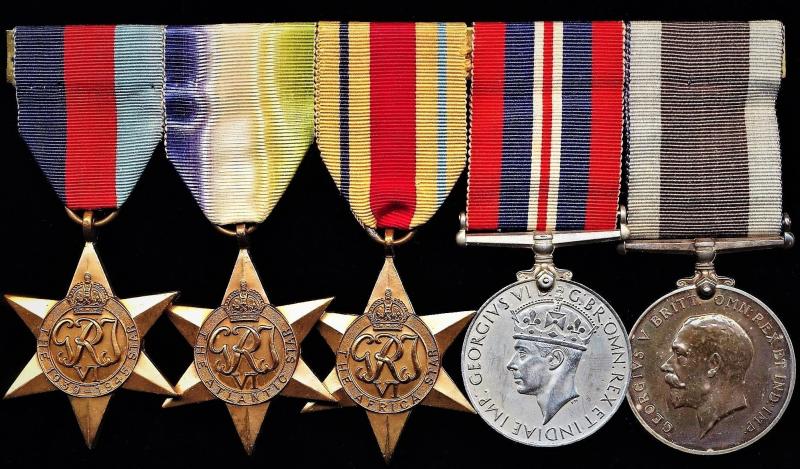
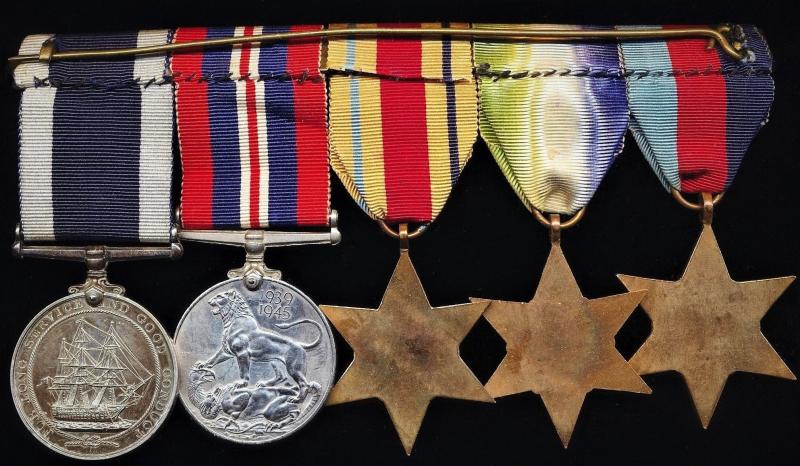
A confirmed 'China Gunboat' Yangtze River 'Panay Incident 1937', & WW2 Long Service medal group of 5: Able Seaman Leslie Charles Frank Cass, Royal Navy late H.M.S. Bee
- 1939-45 Star
- Atlantic Star
- Africa Star
- War Medal
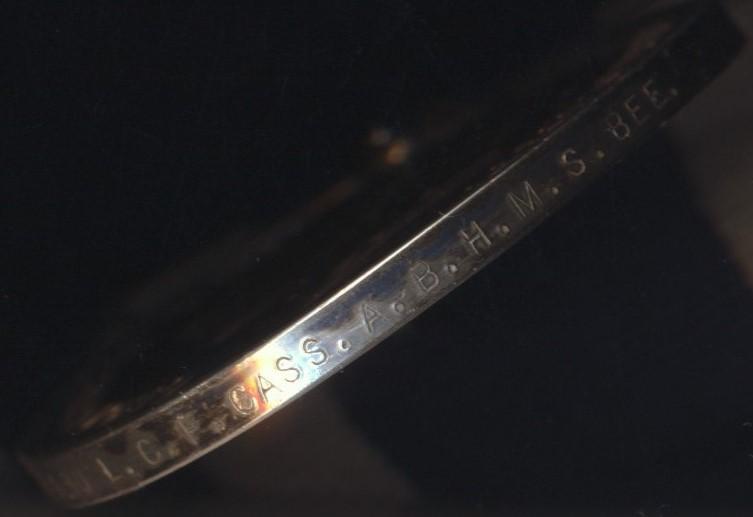
- Naval LS&GC. GV 3rd type (J.95180 L. C. F. Cass. A.B. H.M.S. Bee.)
Medal verification: The Naval Long Service & Good Conduct Medal is shown as 'Traced' in his 'Service Sheet' on date, 7 May 1936, and recorded in the respective Naval LS&GC Medal register (ref ADM 171/143)
China River Gunboats: Leslie Cass, served in the Far East during the Inter-War years, specifically 'Yangtze River'service aboard the River Gunboat 'H.M.S. Bee', from 21 February 1936 to 2 June 1938 (after which on the China Station he mustered on H.M.S. Enterprise - a Light Cruiser- from 3 June 1938, for his return to the United Kingdom)
H.M.S. Bee: Was an Insect-class gunboat of the Royal Navy, launched on 8 December 1915. This class are also known as "Large China Gunboats". Initially built for service on the River Danube, after the Great War the Insects were transported to China and served on the Yangtze River. In 1920, Bee became the flagship of the Yangtze patrol. On 12 December 1937, Bee, along with Ladybird, became involved in the Panay incident and came under fire from a Japanese artillery unit near Wuhu on the Yangtze. Ladybird took six shells and Bee dodged a shell as she came upon the scene.Bee was paid off in 1938 when the gunboat Scorpion, the new flagship, arrived. She was sold in Shanghai for scrap on 22 March 1939 for £5,225
Panay Incident: The United States Navy River Gunboat 'Panay' - was sunk by Japanese air attack - in a sensational unprovoked act of aggression against the United States. The attack on the USN 'Panay' and several US Merchant vessels, in which several American naval and civilian personnel were killed was a deadly harbinger of worse to come in the Far East in 1941. The sinking of the USN 'Panay' was the first loss of any American naval vessels to airborne attack. The British Gunboats Ladybird and Bee, subsequently transported the survivors of the 'Panay Incident' to safety
Leslie Charles Frank Cass, son of Albert Edward Cass (a Fruiterers Storeman) & Elsie Cass (nee Sandy), was a native of the ancient parish of St. Mary Extra, Southampton, Hampshire, England, where he was born on, 20 June 1903. By the time of the 1911 National Census for England & Wales, Leslie was still at School, and was living with his parents and 3 x siblings, viz; 2 x brothers, Albert Edward Cass & Richard Alexander Cass together with a sister, Elsie Agnes Cass, at the family residence located at, 22 Orchard Street, Newport, Isle of Wight. Prior to joining the Royal Navy on, 14 May 1919, Leslie had been employed as a 'Rivet Heater'
After joining the Royal Navy, Leslie first rated 'Boy 2nd Class'. During the inter-war years, Leslie mustered aboard a wide variety of ships, including: the 'Protected Cruiser' H.M.S. Powerful (1919); the Dreadnaught Battleship H.M.S. Iron Duke (1921-22); the Light Cruiser H.M.S. Champion (1927-28); the Heavy Cruiser H.M.S. Suffolk (1928-30; the Battleship H.M.S. Nelson 1931-32); the River Gunboat H.M.S. Bee 1936-38; the Light Cruiser H.M.S. Enterprise (1938) and the Destroyer H.M.S. Cleveland (1941). Immediately prior to the Second World War he had in 1939 been attached to the Royal Naval Police (the 1939 National Register for England and Wales, refers). After leaving the Royal Navy, Leslie migrated with his wife and family to New Zealand, where he is recorded as having latterly resided at the Ranfurly War Veterans Home, Auckland, and where he died on 15 May 1987
The recipients service sheets are extant and accessible at The National Archives
The medals mounted as-worn in the swing style (the Africa Star riband now loose), suspended from their silk ribands. The reverse of the mounting bar retaining the original long hinged pin & clasp fittings
Condition: GVF
Code: 21405